A Bach Pilgrimage
Preface
I was not exposed to classical music as a child, so the first time I remember taking a serious interest in Bach’s music was when I went to see, in my teens, the wonderful documentary film of the 1958 Newport Jazz Festival, Jazz on a Summer’s Day. Between the live stage performances, there is an atmospheric scene with Nathan Gershman playing Bach’s Cello Suite No. 1 in a darkened apartment, pausing briefly before the end of the Prelude to smoke a cigarette! Although there is so much music to admire in this film, it was this short Bach sequence that made the deepest impression on me. I immediately sought out the six Cello Suites, and they have been the backbone of my listening ever since. I will try to describe why the music of Bach means so much to me in future posts; but for now, suffice to say that I felt driven to visit the places where J.S. Bach wrote such wonderful music, and had a yearning to get a feel for the places he lived and worked. I couldn’t really contemplate a trip before the fall of the socialist government in East Germany in 1989, but with the reunification of Germany in 1990, Bach’s homeland, for the first time in 50 years, became easily accessible. It still took me another 30 years to get there; although I suppose I have now benefited from the impressive restoration of churches and towns, and the establishment of world-class museums following reunification.
.
I made the trip in September 2023 and gave myself two weeks to cover Bach’s journey from Eisenach to Leipzig, via Anstadt, Mühlhausen, Weimar, and Köthen. With limited time, I focused on the places where he worked, and therefore did not get to the towns of Ohrdruf and Luneburg, where he briefly studied. I did stop off in Erfurt on the way back from Mühlhausen, as it is a beautifully preserved medieval town, with some Bach connections.
The journey started with a flight to Berlin on 2nd September 2023. I had never been to Berlin, so I gave myself a few days to explore. Bach did visit the city on several occasions, and his two eldest sons spent a considerable time in the city. I was blessed with sunny, warm weather for the entire two weeks I was in Germany, and really enjoyed walking this fine city, which I may describe more in another post! I had prebooked most of the rail journeys this trip using the DB rail app. On the 5th September, I boarded a train for Eisenach, to start my pilgrimage proper. My family is embarrassed by me calling it a ‘pilgrimage’, and whilst I admit that this trip was secular in nature, to me it really was a very spiritual journey.
For anyone planning a similar trip, I would highly recommend the book, Exploring the World of J.S. Bach, A Traveler’s Guide by Robert Marshall and Traute Marshall, published in 2016.
(All photos, except the opening of the Bachhaus, taken during this trip)
Eisenach (5th-8th September)
J.S. Bach was born in Eisenach on 21 March 1685, in a house that unfortunately has long since been demolished. Two days later, he was baptised in St. George’s Church (Georgenkirche). Eisenach is a relatively small town in western Thuringia, with a population of 42,000. The state of Thuringia is rightly described as the ‘green heart’ of Germany, and the small amount I managed to see looked beautiful, with lots of medieval towns and hiking trails through extensive ancient forests. I would love to go back to properly explore.
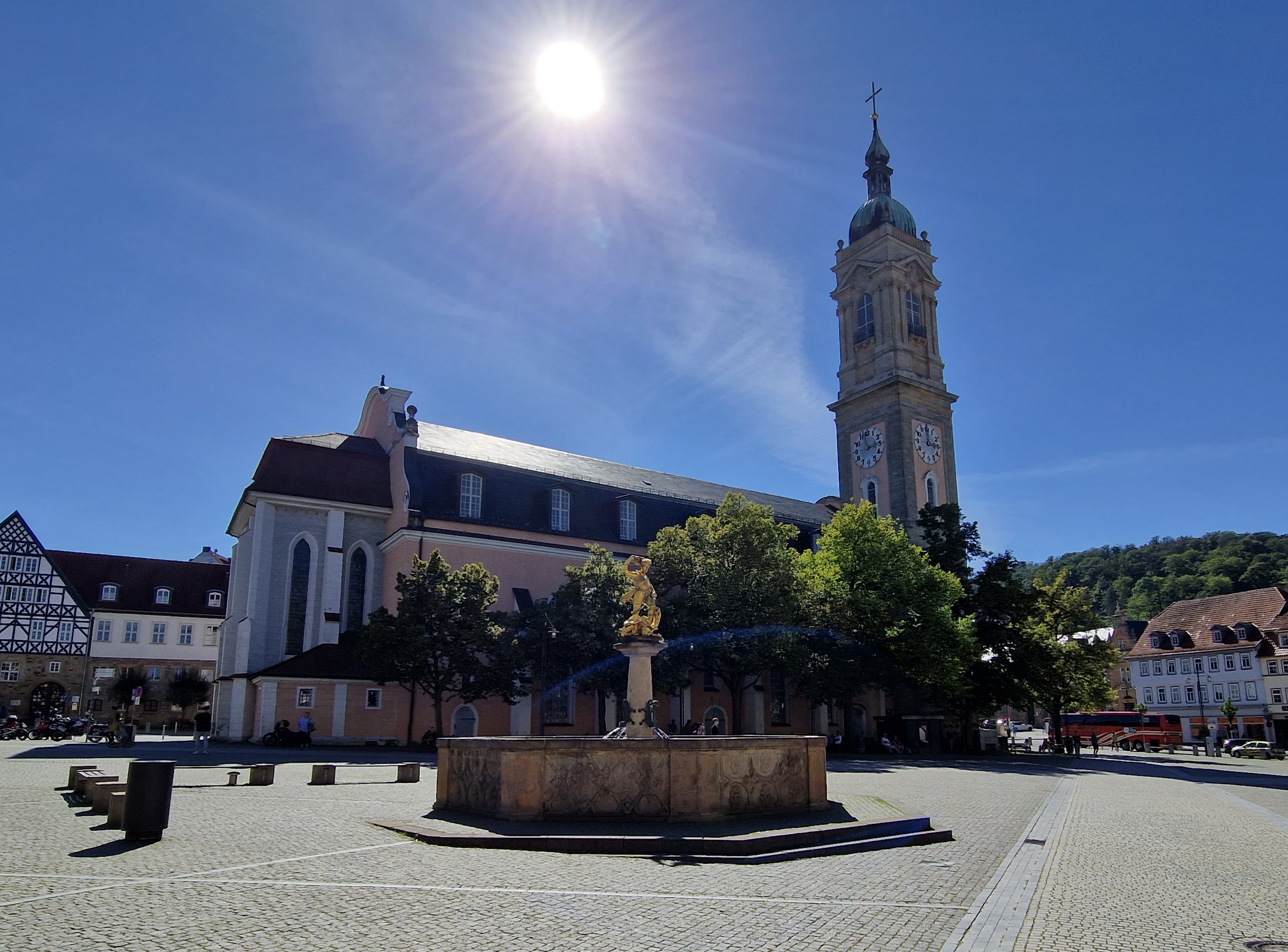
As I was travelling by train, I tried to book hotels near rail stations. I found the choice of hotels limited in Eisenach, but found the City Hotel, which is a 10-minute walk from the station. From there it was a five-minute walk to the town square and St. George’s Church, which of course was my first port of call. I arrived on the square on a beautiful late summer afternoon, with all the surrounding buildings looking radiant in the late afternoon sunshine. When I got to the doors of the church there was a sign saying closed. I was so disappointed; however, I could see people in the pews, and thought that perhaps it was now open, so went in and sat at the back. I soon gathered that people were there for a J.S. Bach concert performed by around 12 singers, accompanied by a small organ and a Baroque cello. I was surprised to find that the musicians and audience all seemed to be British. It was a blissful hour or so listening to wonderfully sung Bach cantatas and choral music, especially poignant being in front of the font that J.S. Bach was baptised in! At the end of the concert I approached an official-looking lady with a clipboard to ask about the concert. After her asking me “who are you”, which was confirmation that I was actually gate crashing, she explained that this was a private tour, and they were visiting several ‘Bach’ churches, concluding with a concert performance at St. Thomas’s Church in Leipzig. When I explained that I was also following Bach’s path across Germany, she very kindly informed me of the dates of the other concerts planned. Unfortunately these didn’t match my more leisurely train itinerary, but I was very grateful for this special experience in St. George’s Church.
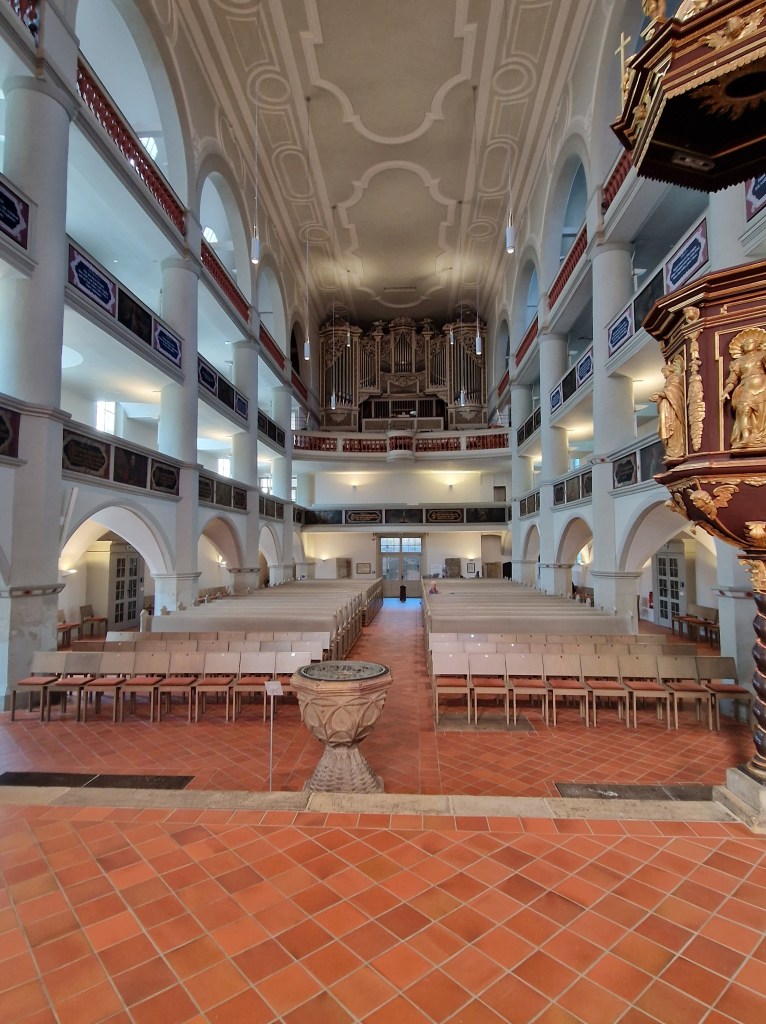
The next morning, after a rushed breakfast, I was back in the market square (Marktplatz). Another beautiful day, with the market square again bathed in warm sunshine. St. George’s church has been extensively renovated over the years, with the neo-Baroque tower being added around 1900. It does look magnificent, sitting in the middle of the rather large square. This time I found the church not only ‘properly’ open, but also empty. There is a statue of Bach in the entrance to the church, which I thought was a nice homage. The interior, with its three gallery levels, dates from the mid-sixteenth century, and was given a makeover in 2014. It does look splendid, painted mainly white, with red and gold trim. The font, which Bach was baptised in on the 23rd of March 1685, stands prominently at the foot of the pulpit. It was such a peaceful space that morning, and although I was keen to get to the Bach Museum (Bachhaus), I found myself sitting in the pews for around 30 mins, just taking in the ambience.
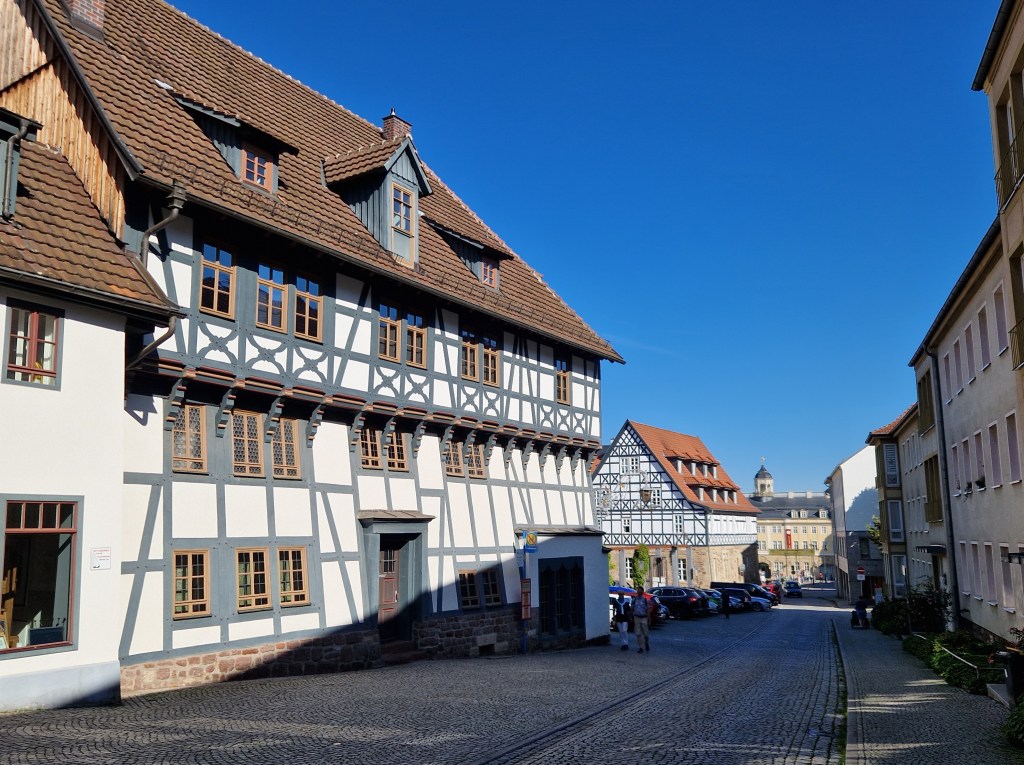
From the market square, it’s a five-minute walk to the Bach Museum (Bachhaus). On the way, you pass the Martin Luther House, which he lived at between 1498 and 1501, while attending the Latin School in the town. It looks a very fine, well-maintained, half-timbered building, which I rather regret now not visiting. I had a vague understanding of Martin Luther’s role in the Protestant Reformation, with his beliefs forming the basis of Lutheranism, but hadn’t realised at the time that Luther played such an important role in the development of music across Germany. He held a core belief in the power of music within religious services and placed music education only second to theology. It certainly led to a high level of musical knowledge and competency across the central German states; although it did seem to be at the expense of any science teaching! If J.S. Bach had been born a Calvinist, which, although still Protestant, held opposing views on the role of music (even removing organs from the church), then it is possible that he wouldn’t have become a musician, and we certainly wouldn’t have had all of the great church cantatas, masses, and organ works. Interestingly, though, Calvinism did later have a major part to play in Bach’s musical legacy. His employer in Köthen, Prince Leopold, was a Calvinist, so by not having to focus on producing weekly church music, Bach was able to set down (or finish) some of the most profound instrumental music ever written, which I will discuss more when this essay finally reaches Köthen!
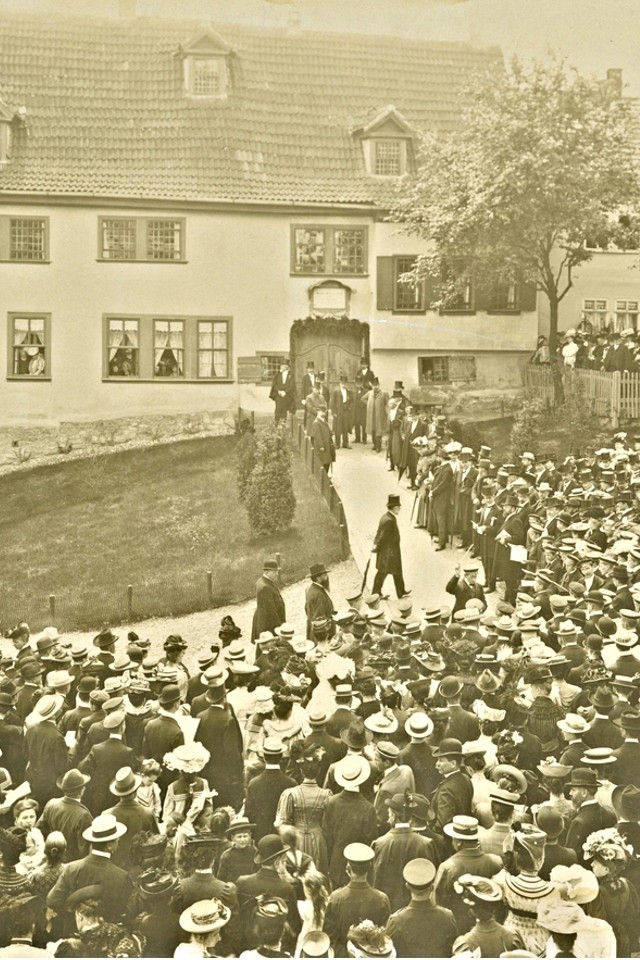
The Eisenach Bachhaus is the oldest museum dedicated to the life of J.S. Bach. It is owned by the New Bach Society (Neue Bachgesellschaft) and was opened on 27th May 1907. The ‘old’ Bach Society was founded by Robert Schumann and Franz Liszt, amongst others, in 1850 in order to publish the collected works, which was achieved by 1900. The photo from the Museum opening is wonderful (see below), and it shows how important Bach was to people at that time, with large numbers of very finely dressed people waiting to get in. I suppose this is a testament to the work of the likes of Schumann, Liszt, and especially Felix Mendelssohn, who at the age of 20 in 1829, single-handedly reintroduced the work of a ‘forgotten’ composer by conducting a performance of the St Matthew Passion in Berlin. He had been given a rare copy of this score by his grandmother for his 15th birthday! Not being a wunderkind, I’m not sure I would have appreciated this on my 15th birthday, but for him it became the ‘cornerstone of his musical faith’. Since J.S. Bach’s death in 1750, his music had, remarkably, fallen into obscurity; however, Mendelssohn’s concert was so popular that it led to the ‘Bach Revival’, which has been gaining strength ever since!
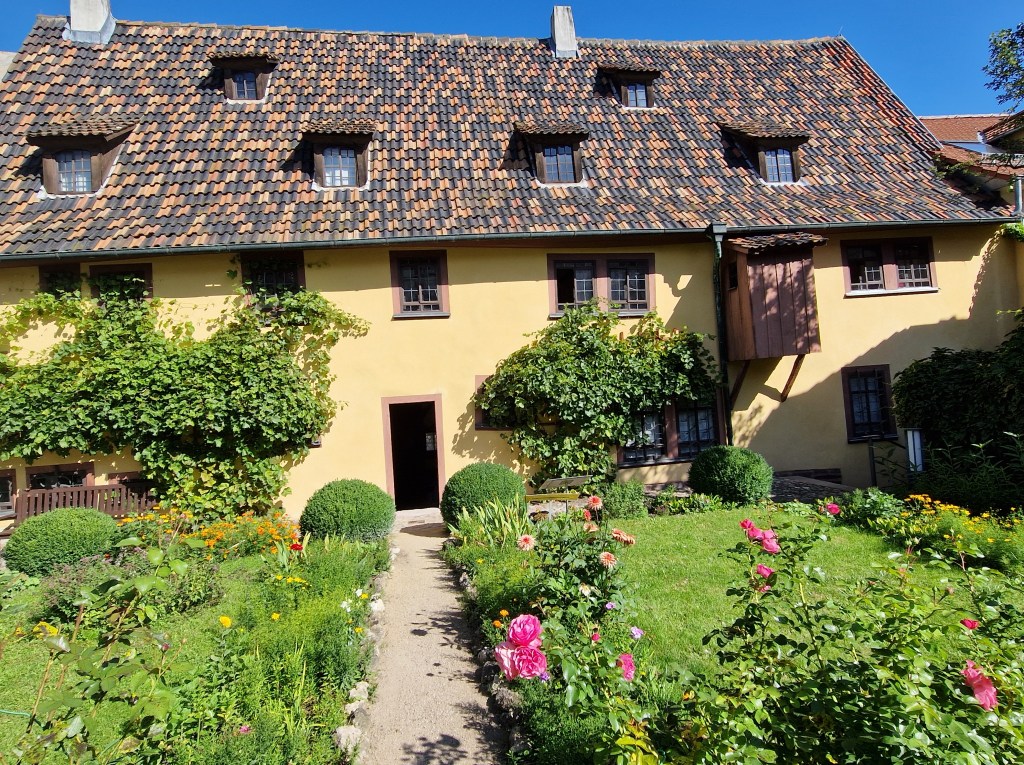
It was believed for a time that the Bachhaus was the birthplace of Bach. The yellow house does date from the mid-fifteenth century, with a new wing added in 2007. I was told, whilst enjoying a beer on the square, that an American officer told his troops ‘not to harm’ the Bach house when they entered the city in 1945. I believe the actual story was that the museum was damaged by Allied artillery fire during the closing phase, but Lt. Col. Knut Hansson ordered that the building be repaired immediately once they had taken control. The original house has a number of rooms (kitchen, bedroom, and living room) furnished with original furniture from Bach’s time. It also has an ‘instrumental hall’ where each hour a member of the museum staff gives a short concert on some of the instruments that Bach would have been familiar with. The new wing has a number of multimedia interactive stations and individual listening posts. I particularly enjoyed reading about some of the technical aspects of his works, and then trying to understand those whilst lounging at a listening station. Have to admit that I mostly failed in this endeavour, but it didn’t stop me enjoying the music! There is a small garden at the rear of the house which looks across to the house that Bach’s father Johann Ambrosius Bach lived in between 1671 and 1674, with his wife and infant son, Johann Christoph (1671-1721).
I couldn’t leave the museum shop without acquiring a bust of Bach, based on the Carl Ludwig Seffner bust. This bust is the logo of the Neue Bachgesellschaft, and was created by Seffner after examining the skull of Bach, which was exhumed in 1894. I hadn’t really thought this through though, as I now had to carry this bust in my rucksack across Germany for the next two weeks!
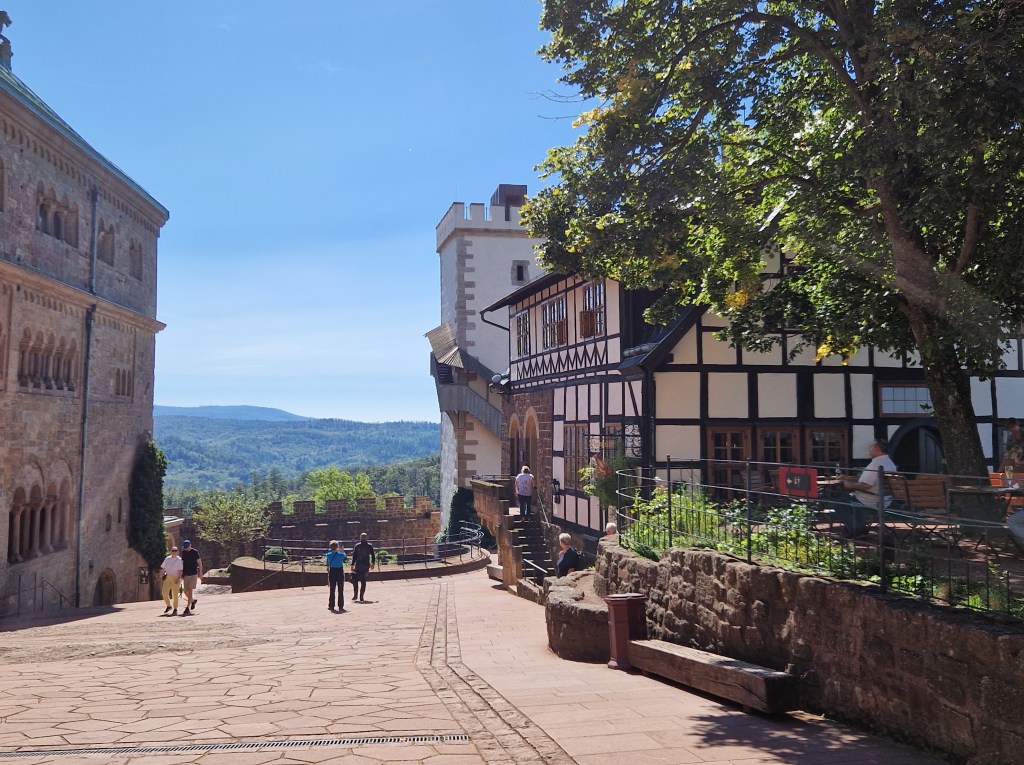
It was still early afternoon, so I thought a gentle stroll up to the Wartburg Castle would be a nice end to the day. I don’t believe it has any direct connections to Bach, but it is such an imposing building standing over Eisenach. I can’t believe that Bach would not have followed this path up the hill, as it is such a lovely walk (30-40 min), starting off in the town, but soon climbing through fairly steep forested paths. The building of the Castle was started in the 11th century, with substantial structures still remaining from the 12th to 15th centuries. It is well worth a visit, even if just for the magnificent views over the Thuringian forest. There is also another link here to the story of Thuringia and neighbouring states becoming a hotbed of Lutheran musical teaching. In 1521-1522, the Castle was used to protect Martin Luther from the wrath of two people that you really wouldn’t want to upset during this period, namely the Holy Roman Emperor Charles V and Pope Leo X. Luther was not one to waste his time in hiding though, translating the New Testament Bible into German, whilst keeping a low profile under the pseudonym of ‘Junker Jörg’.
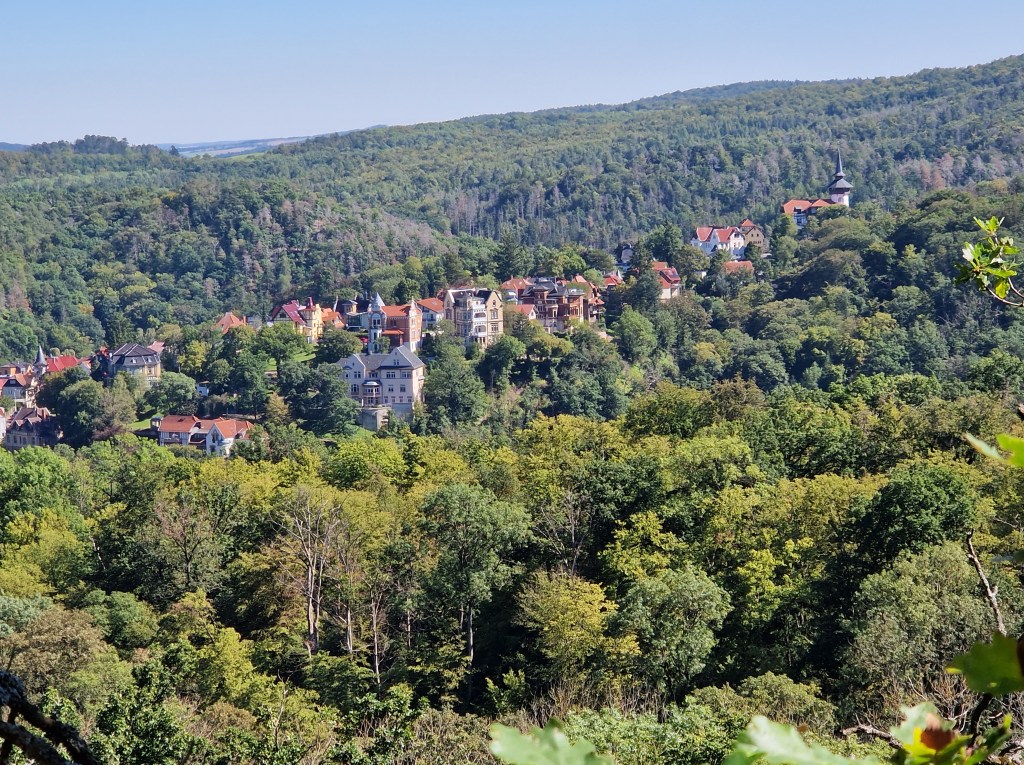
After a pleasant hour in the castle grounds, I walked back down the hill, this time following a slightly longer route that gave great views of Eisenach. I finished the day in the Market Square, enjoying the late afternoon sunshine with a bowl of pasta and another well-deserved German beer.
Eisenach
Arnstadt (7th September)
The next day I was out early to get a train to Arnstadt, where Bach, at the age of 18, obtained his first substantial job as organist of the New Church (Neue Kirche), which he held for four years. He did previously have a low-ranking job as a ‘lackey’ (court servant) at the Weimar court; however, this only lasted six months.
An organ had been commissioned for the ‘New Church’ from one of Thuringia’s leading builders, Johann Fredrick Wender. Bach must have been gaining a reputation in the locality for his organ skills, as he was invited to test and inaugurate this organ. He so impressed the authorities with his knowledge and playing that a month later he was offered the organist role without any further auditions.
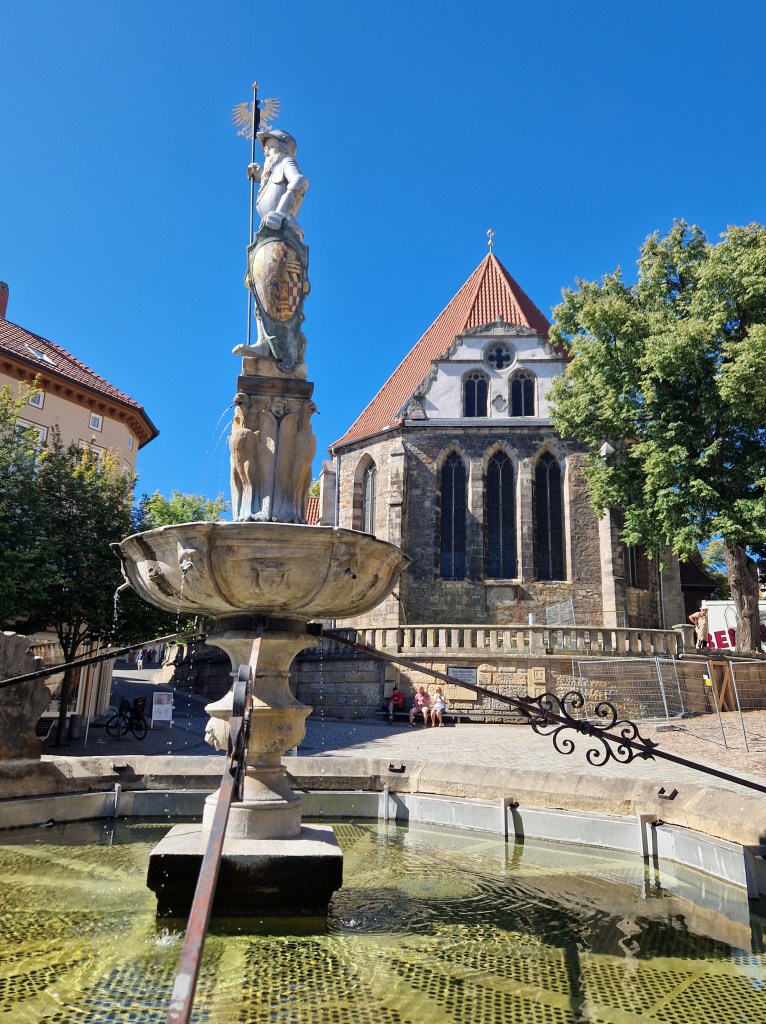
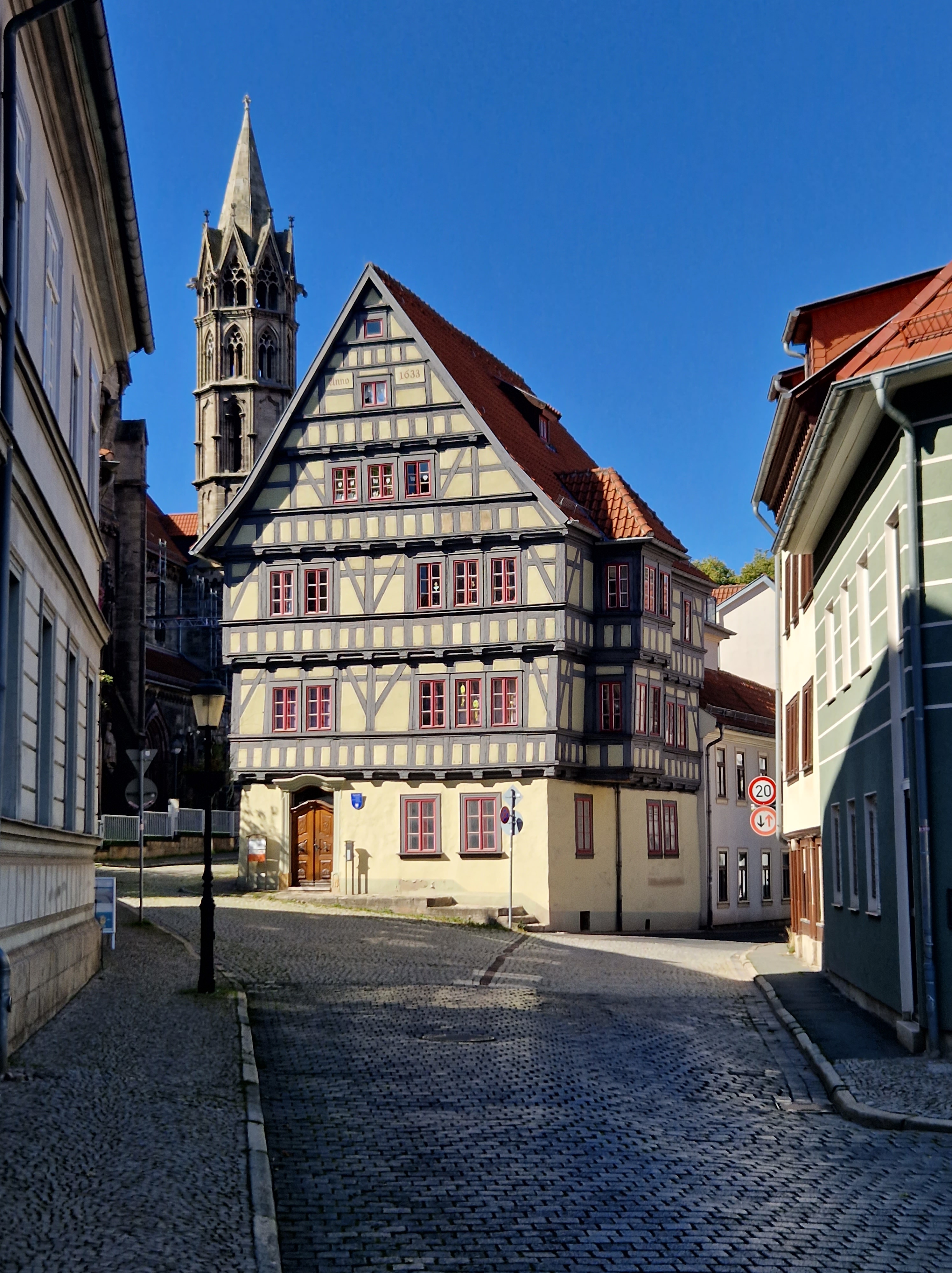
Arnstadt is probably the oldest town in Thuringia, and in Bach’s time had a population of around 4,000 to 6,000 people (now it is a little over 28,000). The direct train takes an ambling two hours from Eisenach, stopping at lots of small, charming-looking towns. You can take a different service, changing at Erfurt or Neudietendorf, which takes less than an hour, but I preferred the opportunity to stare out of the window at the lovely Thuringian countryside. I immediately liked Arnstadt, not only because it celebrates the time Bach was there, but it seems compact, with lots of side streets that are authentically 17th-century (or before). Fortunately, as with Mühlhausen, there was little major damage during WW2, with the centres being largely untouched.
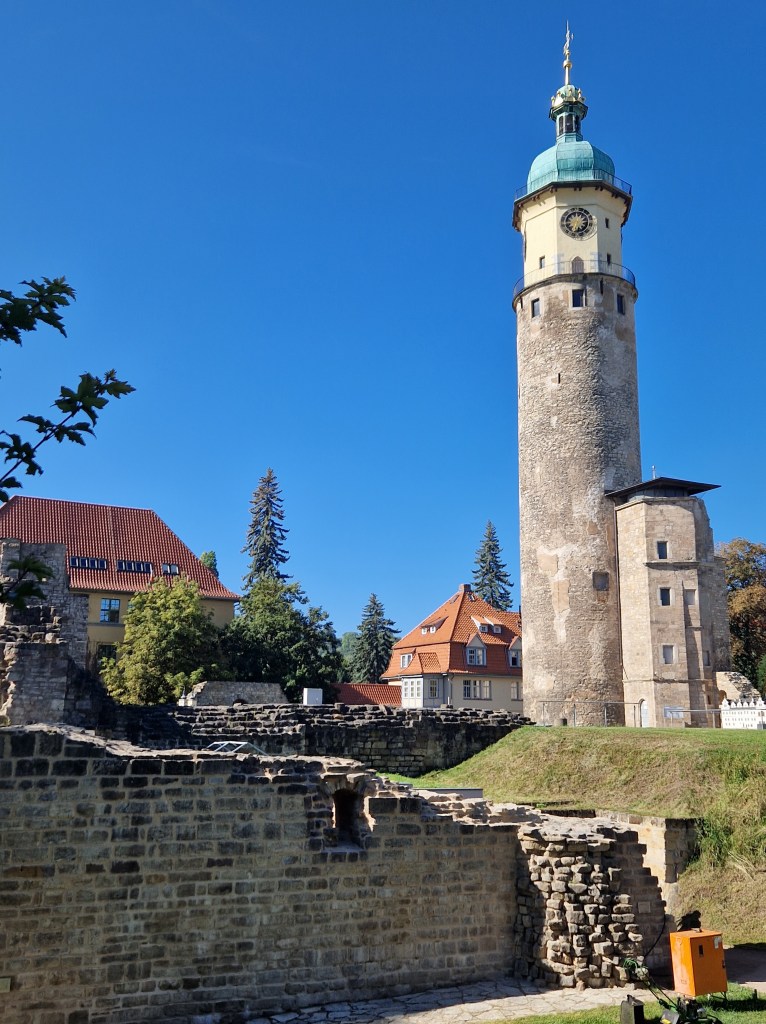
On the way to the town square, I passed the Neideck Castle. Although not much remains, the tower is impressive, standing 60 metres high. Bach would have known the site well, with it dominating the skyline. There is also a family connection, as the first musical Bach to live in the town, Caspar Bach, lived in the tower as the ‘watchman’ from 1620 to 1633.
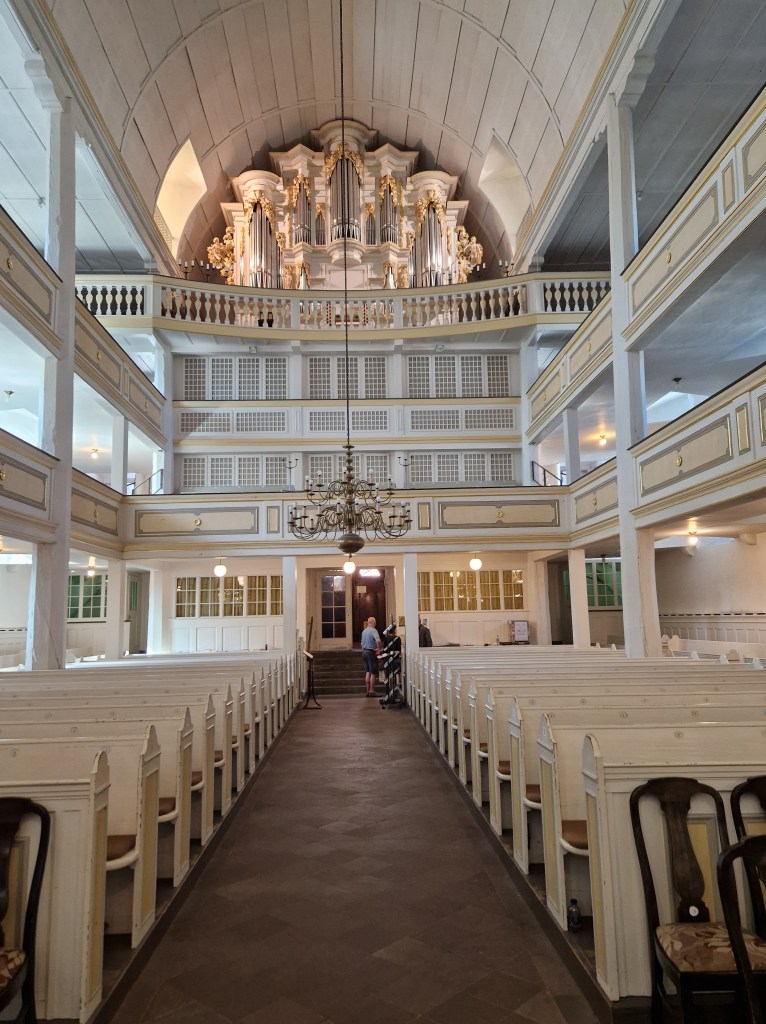
As mentioned, Arnstadt has made the most of its famous inhabitant, with not one, but two museums dedicated to him. The New Church was renamed as the Bach Church (Bachkirche) in 1935. The church was only built a few years before Bach was born, and it was the lowest-ranked of the three town churches. Structurally, both inside and outside, it is how Bach would have known it, although conservative restoration has been performed over the years. The ‘original’ Wender organ is on the third gallery, where Bach would have played it. Although parts of this organ were damaged or removed, the organ case, core pipework, wind chests, and mechanical action are original. A major scholarly restoration took place between 1997-2000, with the emphasis being on restoration rather than replication. It looks magnificent, and I really felt that I was able to stand near an organ that Bach actually played. I do love the simplicity of these small churches. There is certainly a huge contrast to the ornate, golden Baroque churches from this period that I have seen across Europe. Although it is now painted mostly in a serene white, there is a model in the palace museum showing that the interior of the church in Bach’s time was bare wood (it was not painted until 1776).
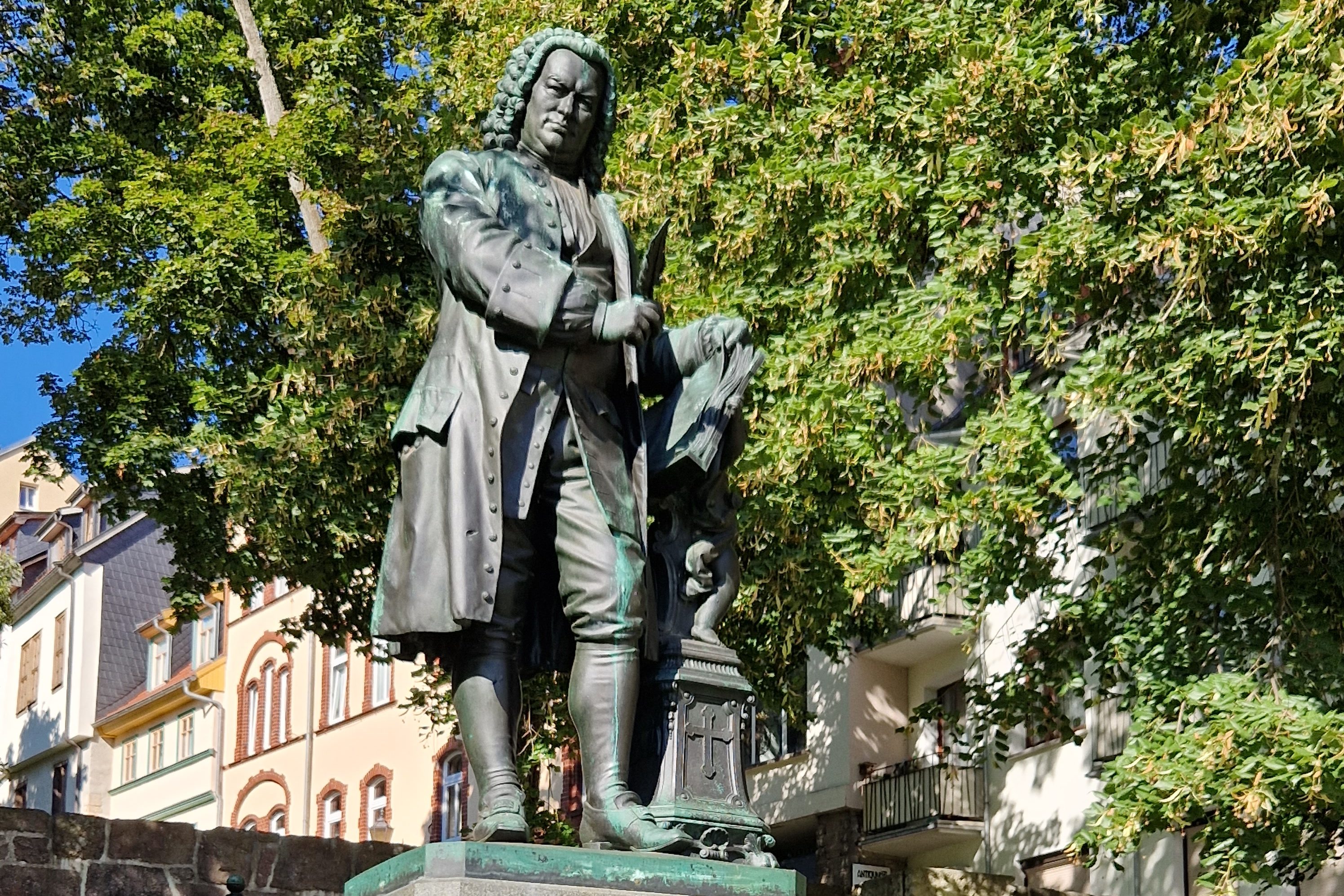
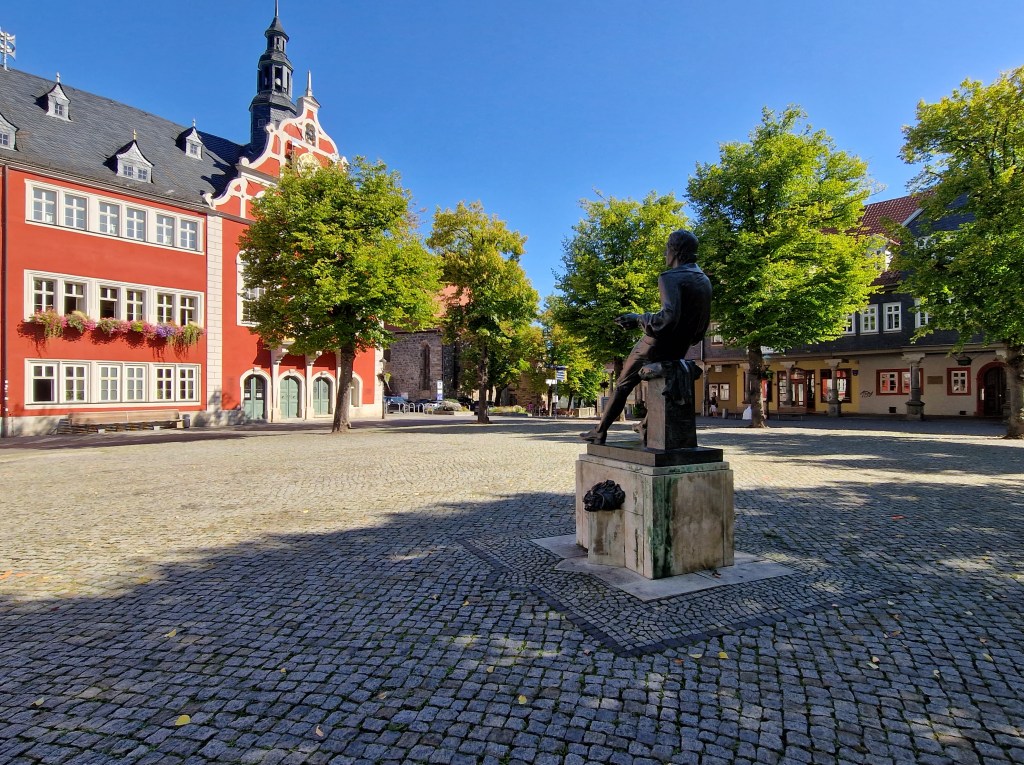
As you can probably imagine, the extremely talented young Bach soon grew tired of simply accompanying the congregation in singing hymns and soon started to embellish, improvise, and add ‘frills’ to his playing. This didn’t go down well with the locals, and they often complained of not being able to follow the tune. As I stood looking down the church, I could just imagine the Lutheran congregation screwing their necks around in the pews to look up at the organ loft and asking ‘what is he playing now!’. Bach did have a ‘run-in’ or two with his employers in Arnstadt, and not only about his flamboyant playing. I believe the slightly odd statue in the town square captures Bach’s character at this time, which for me was that of a very gifted, confident and strong-willed young man.
This Thursday morning, the town seemed very quiet, and I didn’t see anybody that even resembled another tourist. To plan the rest of the day, I had a coffee on the square, overlooking the Bach statue. In that moment, I couldn’t help thinking about the famous altercation that happened just in front of me on the square in 1705. Apparently, the boys of the choir and orchestra that Bach was supposed to teach were a very rough bunch and would wander the streets at night in gangs. One summer evening, Bach was walking home across the market square with one of his cousins, Barbara Catharina Bach, when they were confronted by one of these ‘gangs’. Their leader was Johann Geyersbach, who Bach happened to call a Zippelfagottist at rehearsal, which roughly translates to a nanny-goat bassoonist (but it has been suggested that this may be a polite version of what he actually called him). Geyersbach demanded an apology, and after one was not forthcoming, he set about Bach with a stick. Bach drew his sword, and the two tussled for several minutes, with Bach putting a few holes in Geyersbach’s clothing before the two were separated. Bach complained to the church council about the attack, but after investigating, they found fault with both parties. The council were remarkably patient with Bach over a number of his teaching ‘problems’ and asked him to try harder with the boys; however, Bach was to show another one of his characteristics, an innate stubbornness, and he refused to teach the choir or produce music for them.
With no teaching, Bach had plenty of time for organ practice and composition, making him very accomplished in both realms. At this time, Buxtehude was the recognised master of the organ, and Bach was determined to visit him in Lübeck to hear him play. He managed to persuade the council to give him four weeks’ leave, and so in November 1705, he set off on foot to cover the 260 miles to Lübeck. He did not return until February 1706, with Bach shrugging off the council’s reasonable rebuke for his extended absence. Towards the end of 1706, he was in trouble again with the council for bringing ‘a strange woman’ (thought to be his second cousin and soon-to-be wife, Maria Barbara) into the organ loft. I don’t think this has the same connotations as ‘a roll in the hayloft’, and from viewing the organ in the New Church, there doesn’t seem to be a whole lot of room up there! Five months later, Bach was auditioning for a new position in Mühlhausen.
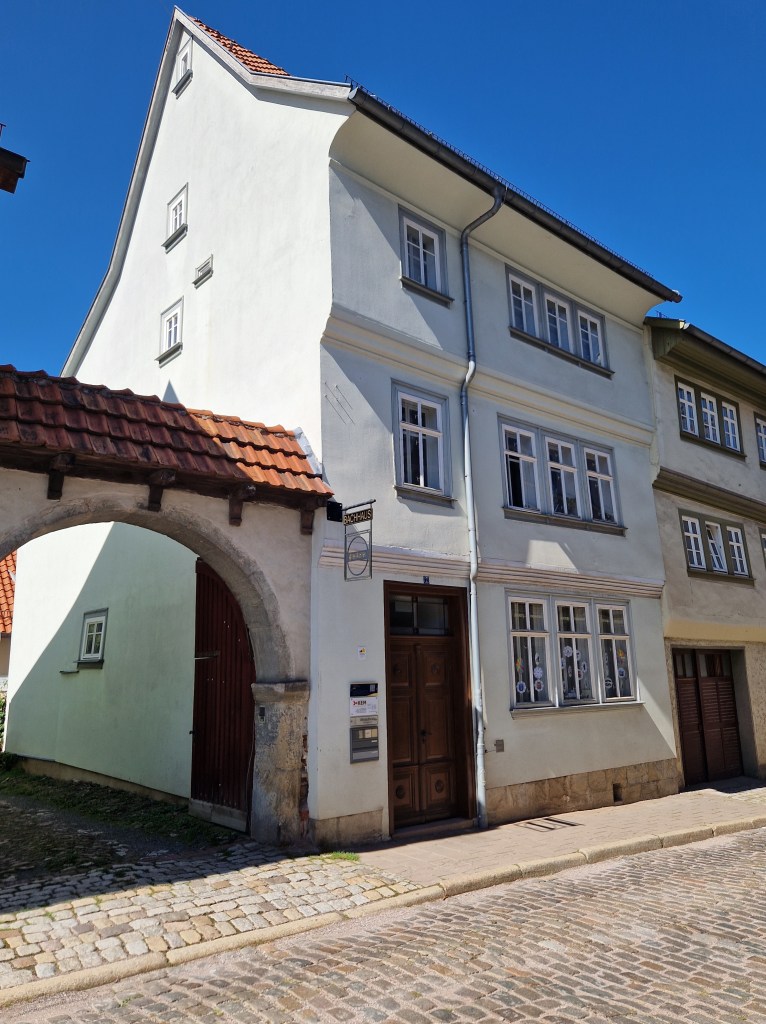
Just off the market square in Arnstadt is the residence of Johann Christoph Bach (twin brother of Bach’s father), which was occupied by his widow and children after his death in 1693. Bach is thought to have lived there when in Arnstadt. It is now a small museum dedicated to early members of the Bach family. Unfortunately it was not open when I arrived, so I headed towards the New Palace, which was on the way back to the rail station. It now serves as the palace museum, with a permanent exhibit ‘Bach in Arnstadt’ featuring the original key desk from the Wender organ, and a model of the interior of the New Church. The museum also has a ‘doll city’ created by the residing princes. This is apparently a major tourist attraction, but although I could appreciate the detail included in the scenes, it was not this tourist’s ‘cup of tea’.
Really enjoyed my day in Arnstadt. Wandering around the cobbled streets of the historic area gave a real insight into life in the early 18th century for our youthful musician. It was tiring though, doing it as a day trip, and I was certainly ready for my late dinner when I got back to Eisenach. Although the next town that Bach was to work in was Mühlhausen, I was out early the next morning to get a train to Weimar and a three-night stay at the Hotel Kaiserin Augusta (opposite the station). I have an admission to make – I was not planning to go to Mühlhausen as I thought I would need more time in Weimar; however, whilst there I realised it would be a mistake to miss out on this town as it did play an important part in Bach’s musical journey. Therefore, using the DB app, I booked another Thuringian rail pass, and early on the 9th September embarked on the one-hour train journey from Weimar to Mühlhausen.
Arnstadt
Mühlhausen (9th September)
The decision to include Mühlhausen was probably the best one I made on this trip. It is a beautifully preserved medieval city nestled in the mountain ranges of Thuringia. It now has a population of around 36,000, but in Bach’s time it was a Free Imperial City of approximately 7,000 people. When Bach moved to the city, it was recovering from a major fire that had rampaged across the centre only a few weeks before. The population had also been devastated by the plague of 1682/83, which killed 4,000 residents. The city boasts 11 medieval churches and has the largest medieval centre of any city in Germany.
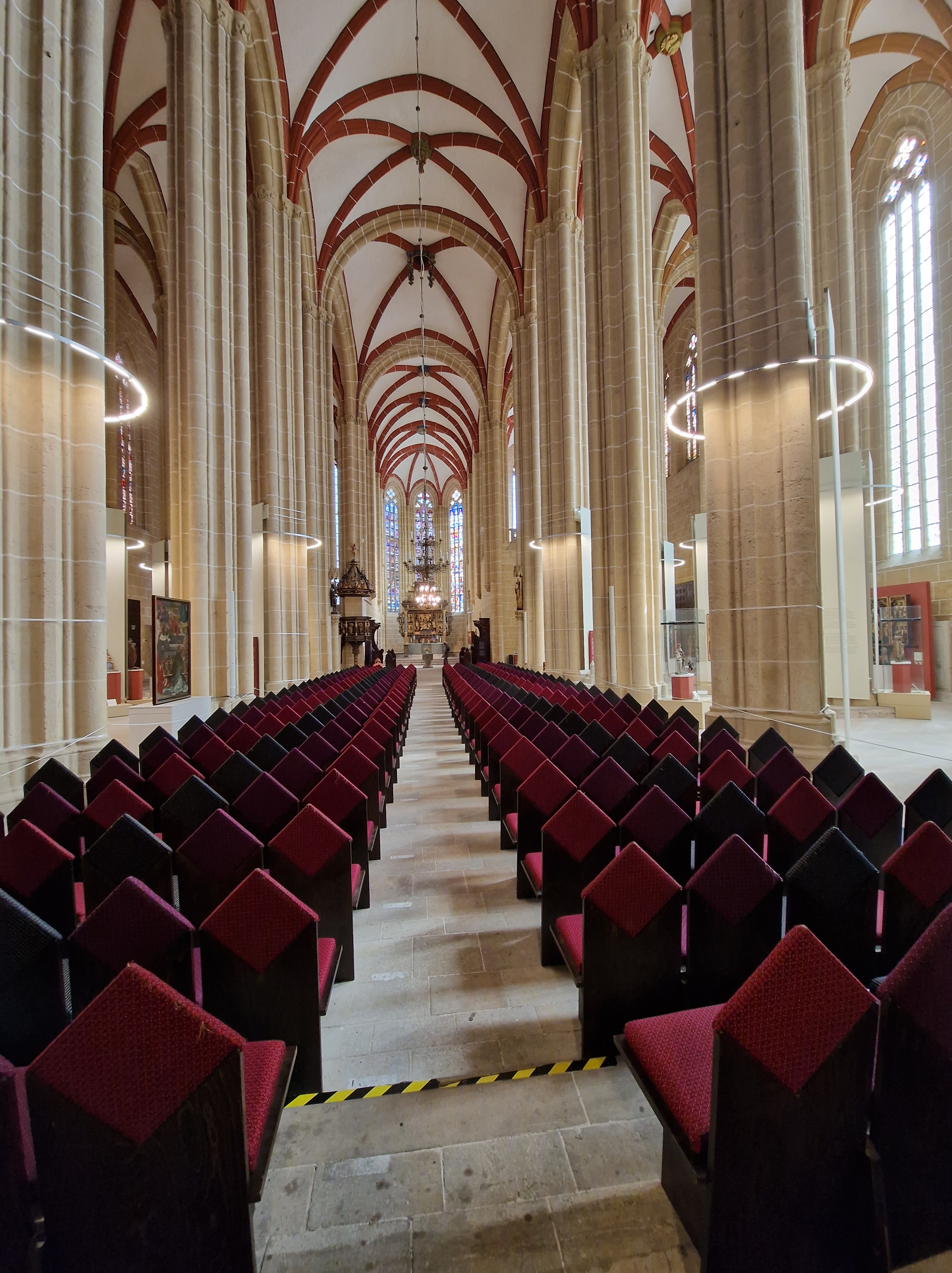
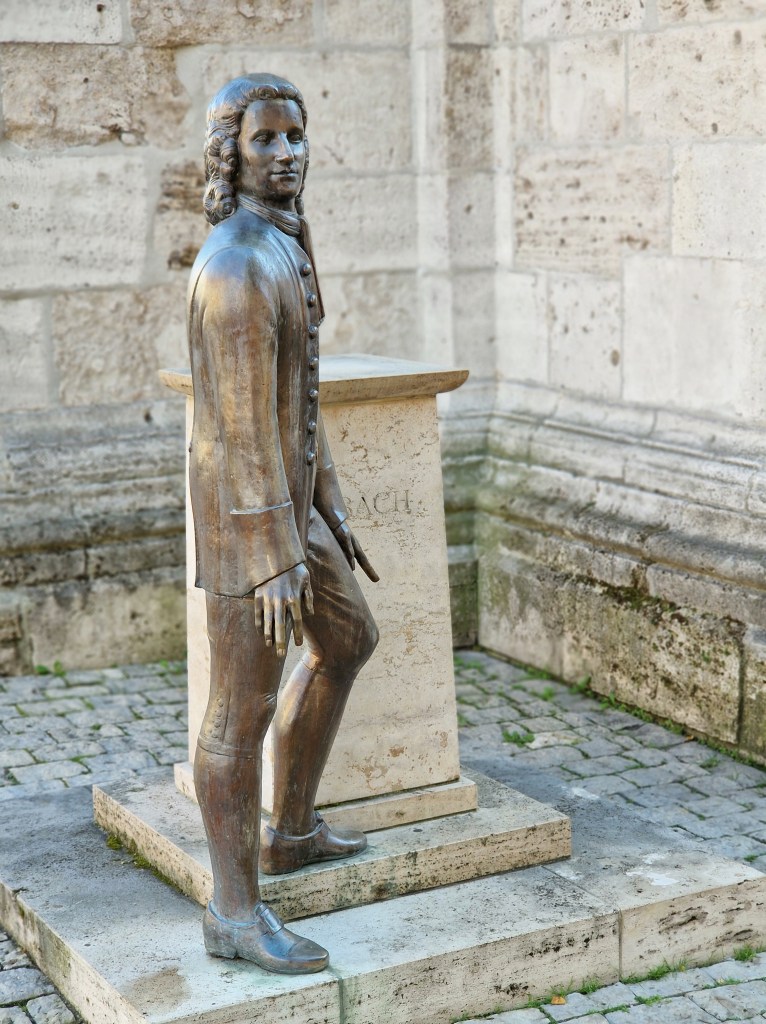
From the station, I walked towards the historic centre of the city, and within 15 minutes had reached St. Blasius’s Church (Kirche Divi Blasii), where Bach was employed as organist in June 1707. He had auditioned for the role back in April and was probably recommended by his good friend and organ builder, Johann Wender, who was a resident of the city. St. Blasius’s Church is a very impressive 13th-century early-Gothic building, one of the most important in Germany. The inside remains much as Bach would have known, with stained glass from the 13th century and the altar, pulpit, and font dating from the late 15th, early 16th century. Even the church bells are preserved, being from 1281, 1335, and 1448 respectively. Unfortunately, the original Wender organ no longer exists; however, the current organ was built in 1959 following Bach’s 1708 proposal for renovation of the St. Blasius’s organ, which Wender completed in 1709. There is a statue outside the entrance to the church, which is probably my favourite of Bach, as it shows the young man stepping up towards a plinth that bears his name, depicting that although he was not recognised as a musical great at this point in his journey, he soon would achieve those heights.
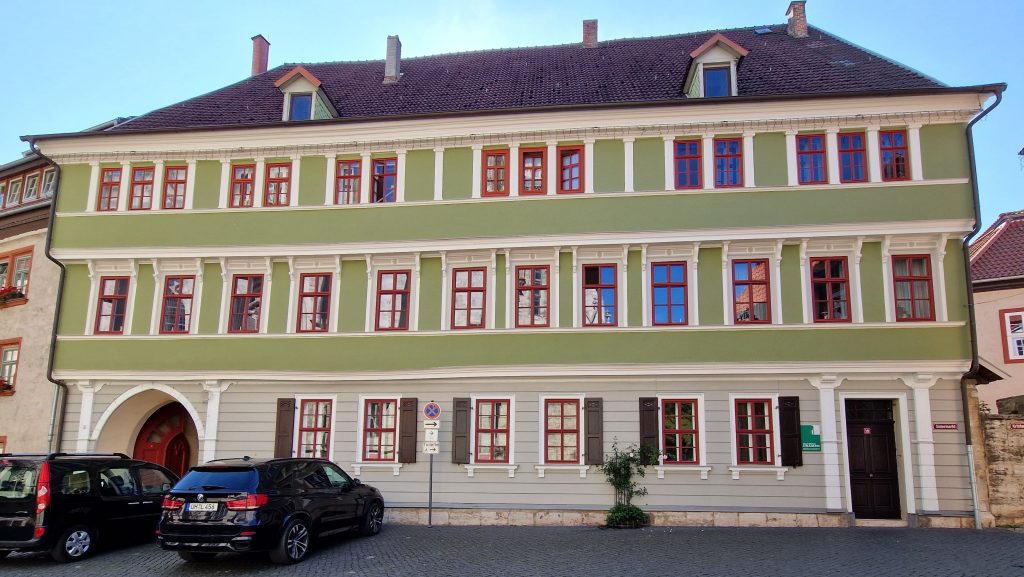
There is an imposing green building standing opposite the church, Meckbach House. It is thought that Bach resided here, and the son of the owner, Paul Friedemann Meckbach, became godfather to Bach’s first son, Wilhelm Friedemann (1710-84).
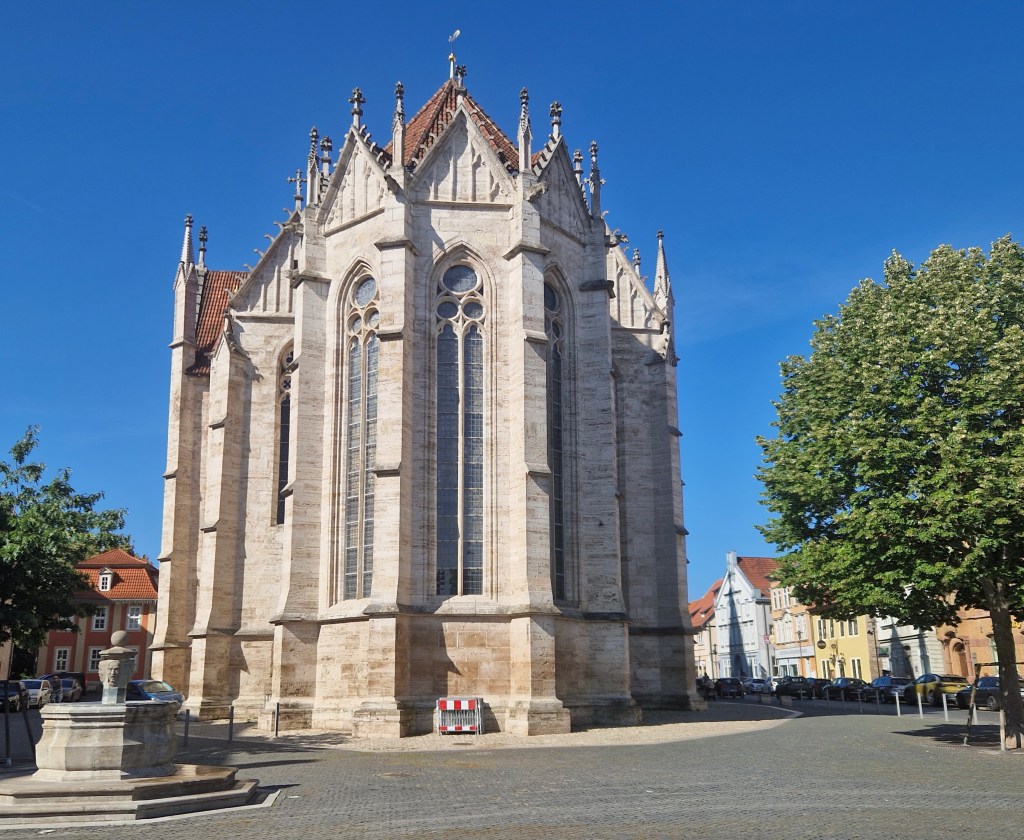
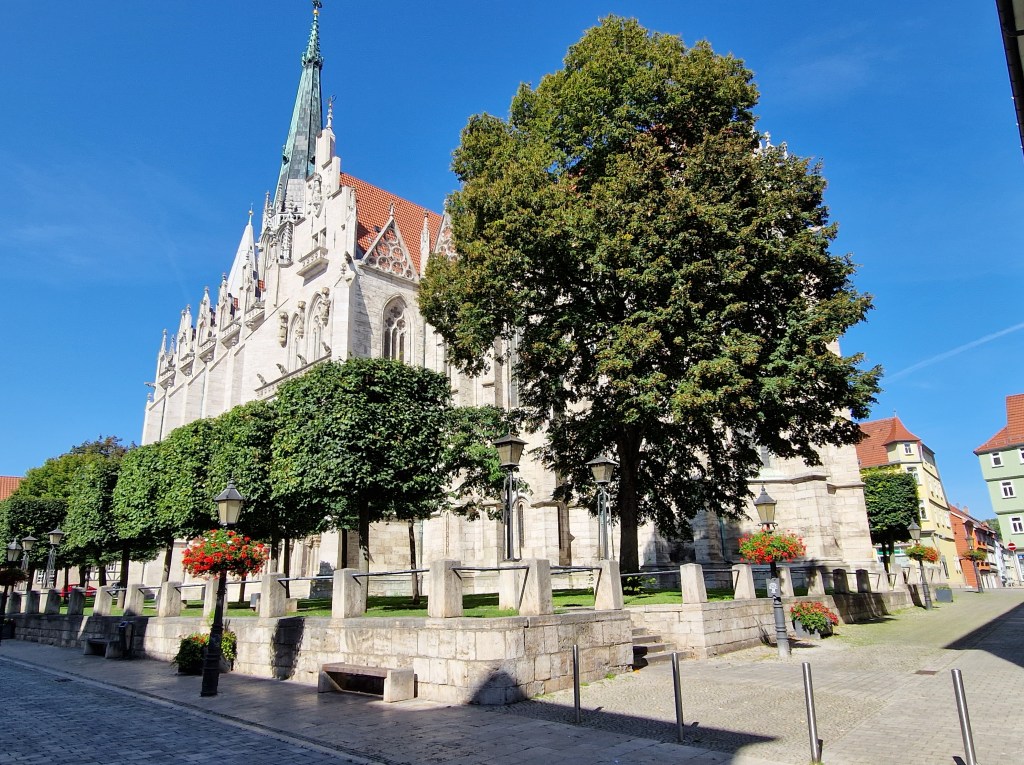
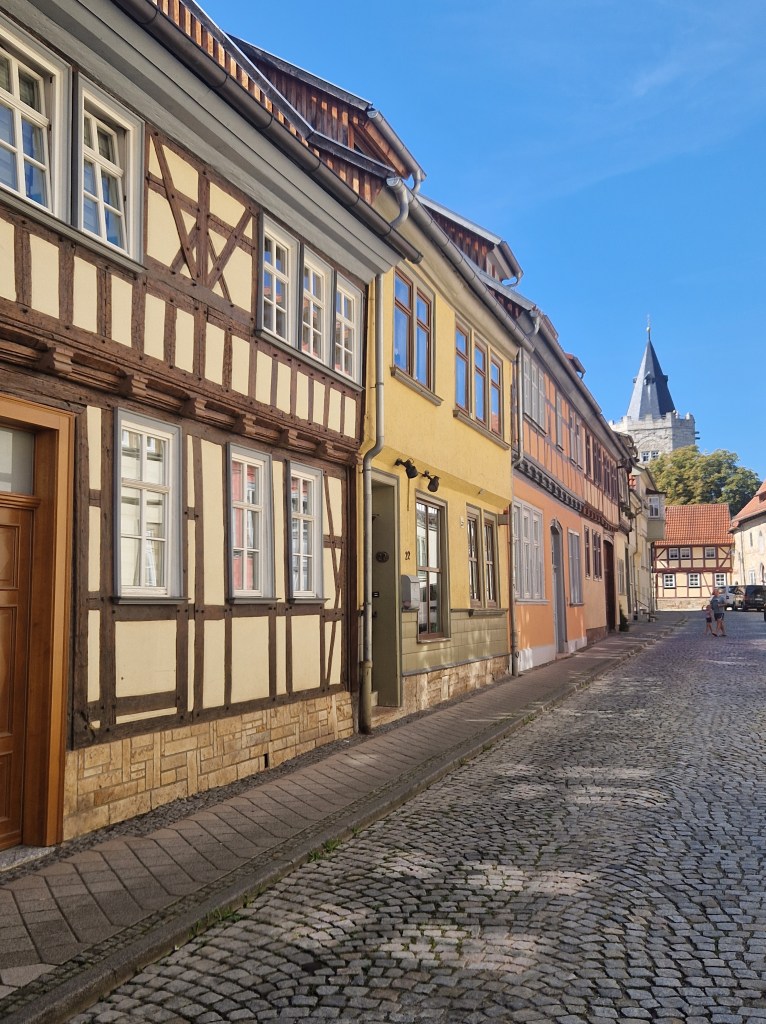
From St. Blasius’s Church, you can walk through a maze of cobbled medieval streets, in the direction of St Mary’s Church. Whilst wandering around these streets, I came across the Town Hall (Rathaus), mainly because I was desperate to find a toilet! This is a fine group of connected buildings, some dating from the 14th century, which hold archives from Bach’s time in the city (and they have a public toilet!). I finally stepped into the square in which St Mary’s Church (Marienkirche) stands, and was very impressed. It looked magnificent in the sunshine, with its pale stone and enormous green-coloured Gothic tower (280 feet, the tallest in Thuringia). I understand that Mühlhausen was prosperous in these times, but to have two very large, beautiful Gothic churches (plus the nine other medieval churches, I didn’t get to see) for a population of 7,000 people seemed rather extravagant.
St. Mary’s Church was built in the 14th century, and was the principle church of the upper city in Bach’s day. Bach did spend time writing music for this church, as the pastor, Archdeacon Eilmar, appreciated Bach’s ambition to expand the musical repertoire of the church. The opposite was true of the St. Blasius’s superintendent, Johann Frohne, who was a pietist, and so was opposed to music as an art form within the church. This must have been an irritation for Bach, and would have been a significant factor for his comparatively short stay in Mühlhausen. He did marry his second cousin, Marie Barbara, during his time here (17th October 1707), but by June 1708 he was petitioning for his dismissal, stating his “final goal” involves creating “well-regulated church music to the glory of God, without further vexation” To the credit of the town council, they agreed with Dr. Meckbach’s argument that “there was no holding him back”, so released him providing that he completed his plans for the renovation of the St. Blasius’s organ.
It was also time for me to move on and head for the train station, but not directly back to Bach’s next destination, Weimar. I was a little torn, as there was a lot more to see in Mühlhausen, but as it was still early afternoon I thought I would make the most of my Thuringia rail pass, and stop off in Erfurt on the way back to Weimar. Although Erfurt it is not a place Bach worked, he had lots of family connections there, and my guide book said it is was one of the best-preserved historic towns!
Mühlhausen
Erfurt (9th September)
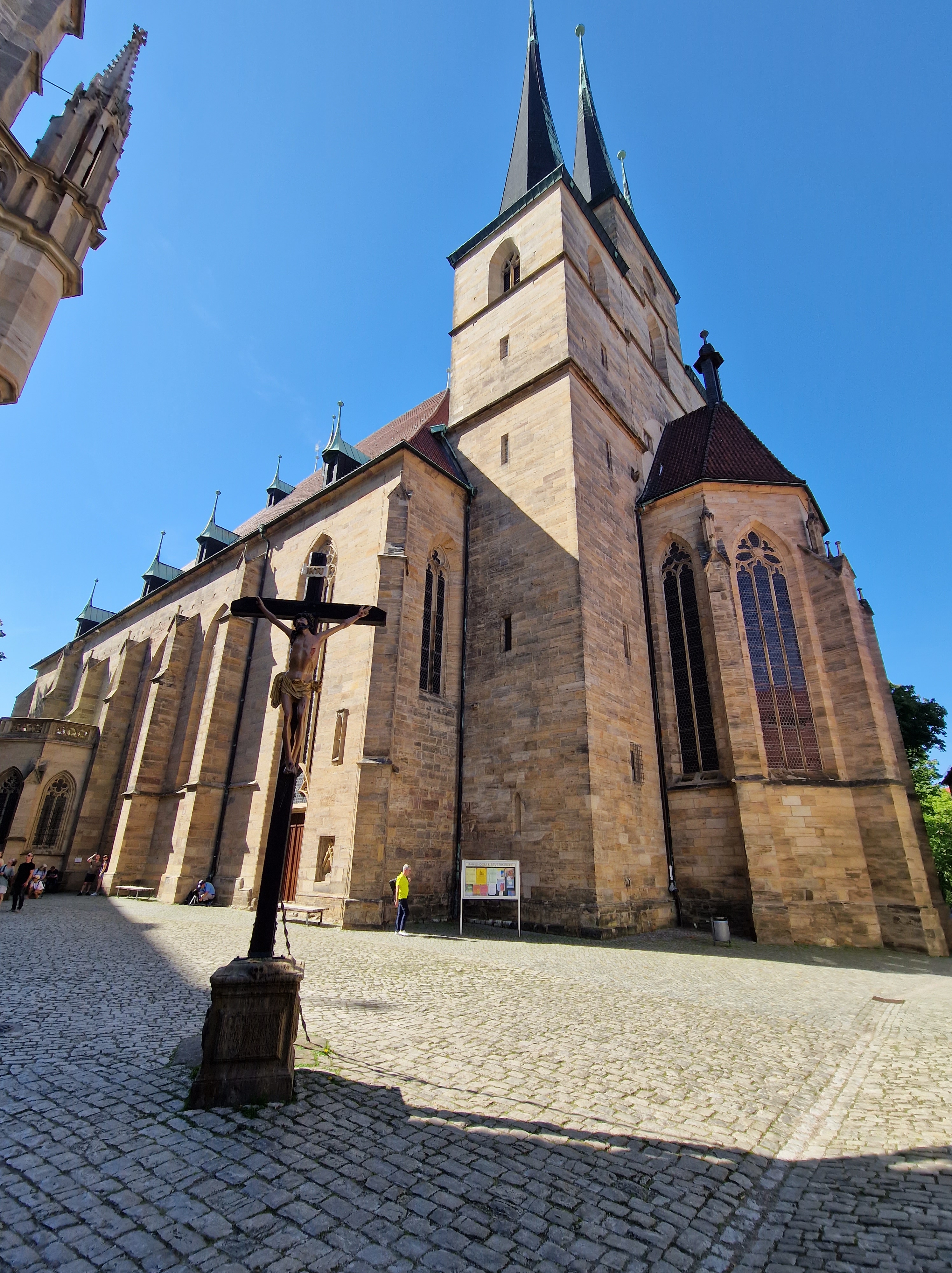
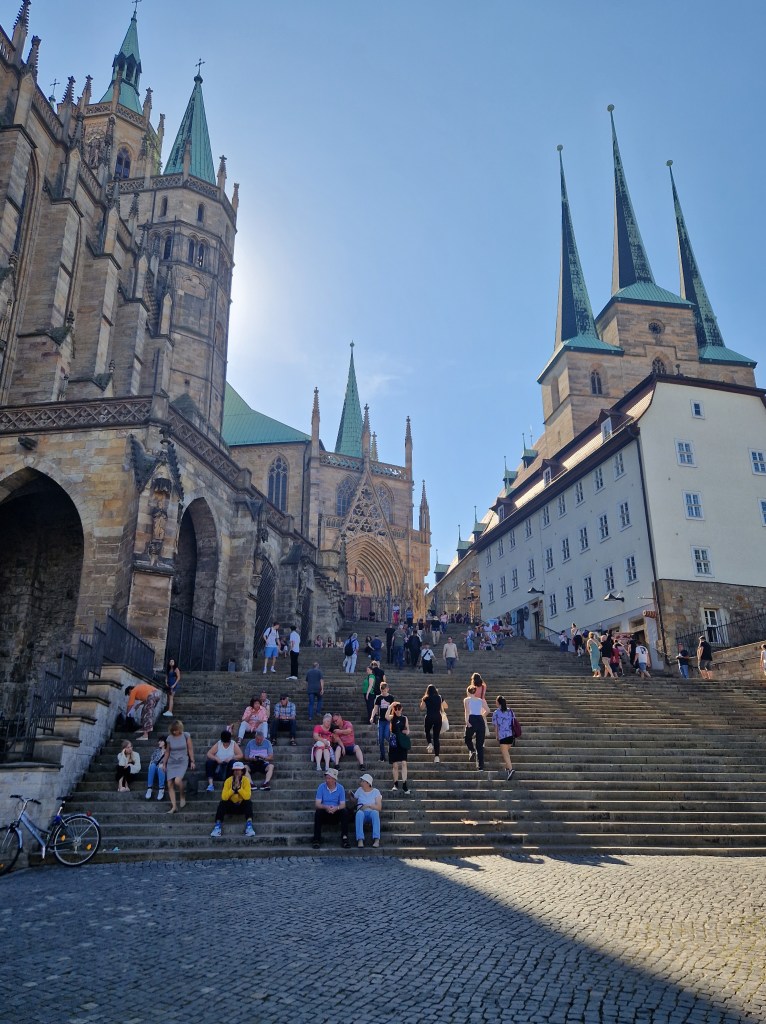
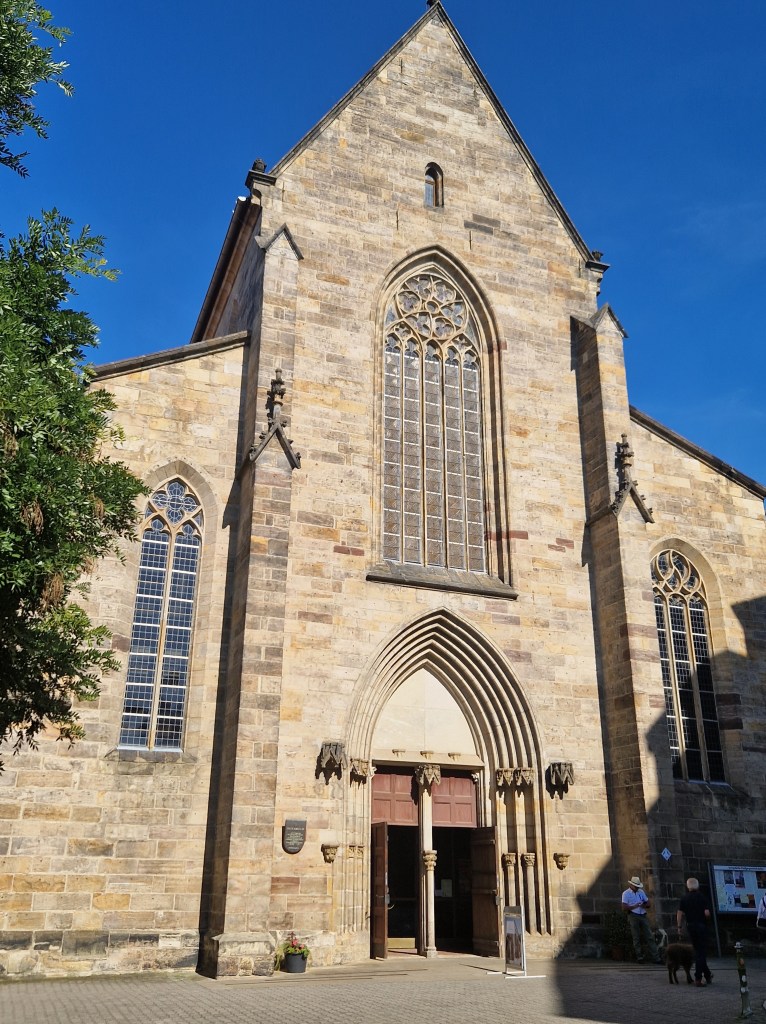
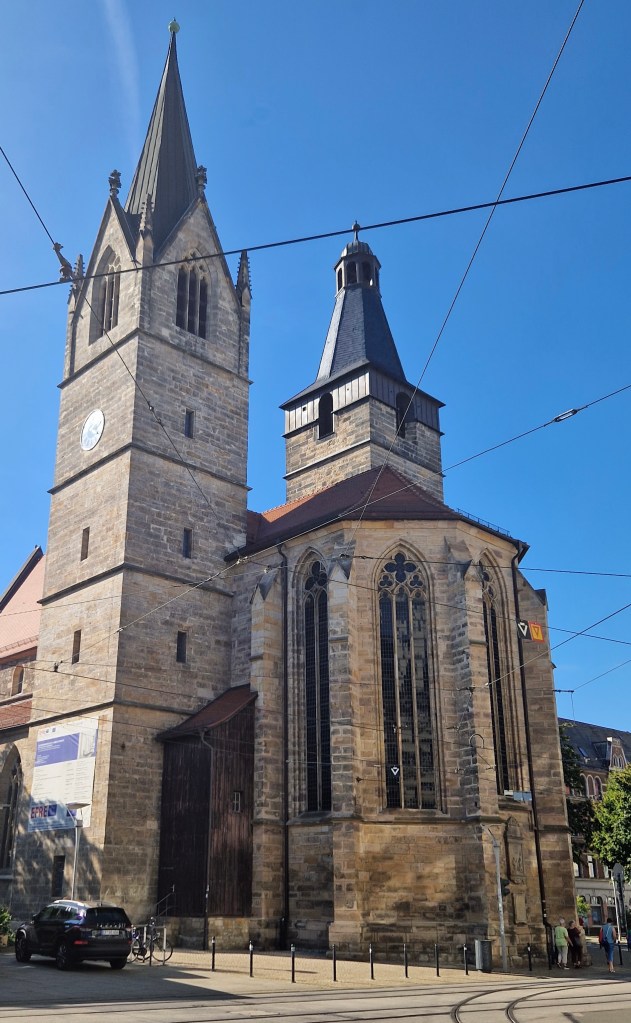
My first impression of the city was that it was much larger, and busier than other places I had seen in Thuringia. It is situated in the wide valley of the River Gera and now has a population of 216,000. I was a bit peeved to see a number of other tourists, as I thought I had Thuringia to myself! I believe the main attraction is the two large Gothic churches that sit on a high point (the Domberg), and are literally only a few metres apart. St. Mary’s Cathedral is more visually dramatic, with its mixture of Romanesque and Gothic architecture, but St. Severus’s Church is also a beautiful Gothic building, and the two standing next to each other is quite a sight. Although there is no direct Bach connection to these churches, he would have known them from his family visits. There is a connection to our old friend Martin Luther though, as he studied at the university here and was ordained as a priest in this Cathedral in 1507. There is also a connection to Bach’s long-time friend, Johann Wender, as he created the organ in St Severus’s Church in 1714, and although rebuilt in 1930, it retains the Wender’s original Baroque organ case.
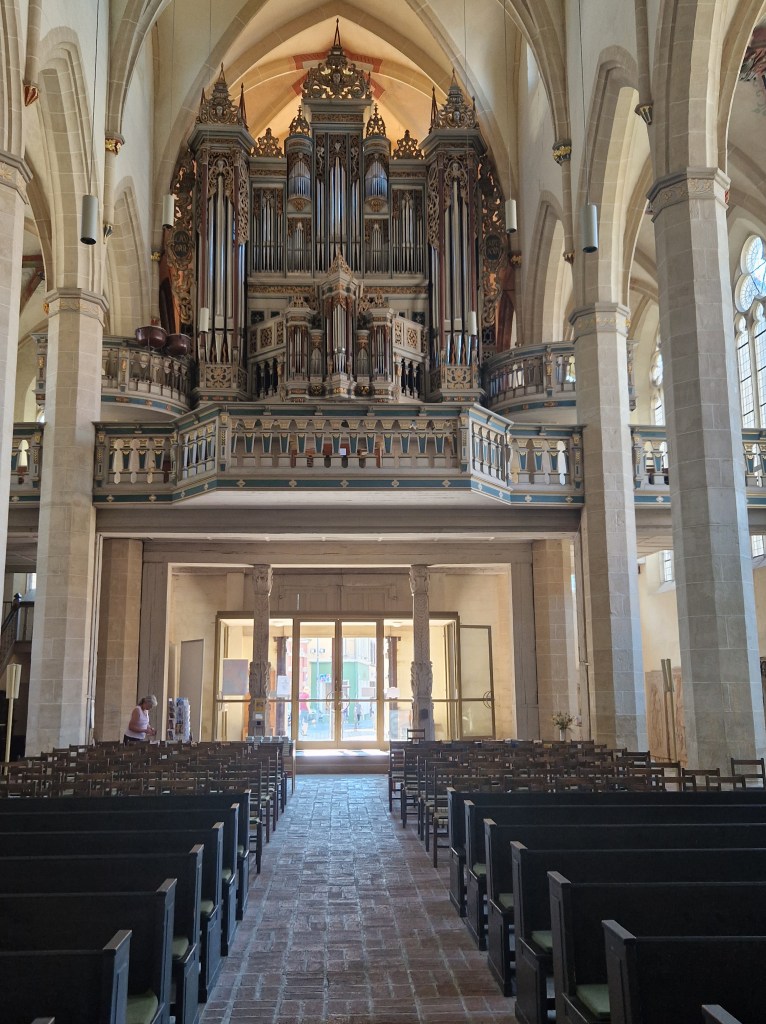
The church I wanted to find was the Merchants’ Church (Kaufmannskirche). It is not as striking as some others, but this is the church that Bach’s parents were married in on the 8th April 1668. As I arrived at the entrance, an attendant was starting to lock the doors for the evening, but she kindly let me in for a short visit. Luther preached here in 1522 and an amazing sixty-one Bach family members were baptised in the font, with twelve married in the church. Unfortunately Erfurt didn’t escape damage during WW2 and there was significant damage to this church. It was not restored completely until 2009. It has an impressive looking organ, and although rebuilt several times, it retains its beautiful Baroque case.
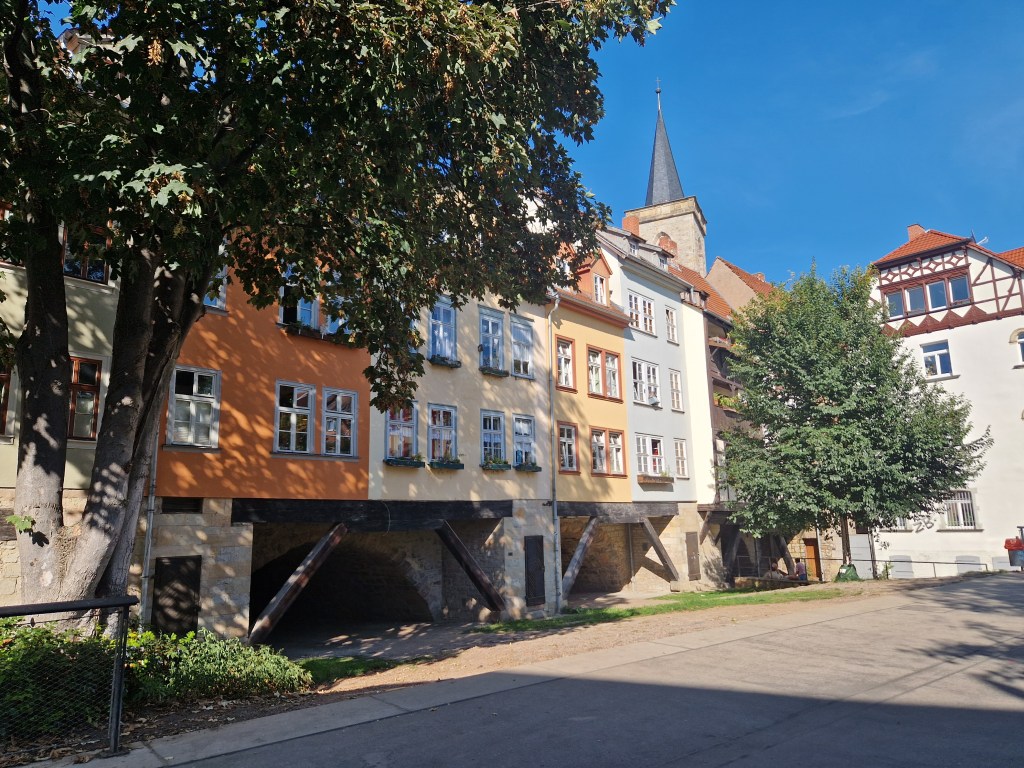
It had been a long day, and as I had not eaten I made my way to the other major Erfurt attraction, the Merchants Bridge (Krämerbrücke). It is certainly an Erfurt landmark, being an exquisite 14th-century stone bridge covered with half-timbered houses. It is one of the few remaining inhabited bridges in Europe, and now has lots of little stores selling handmade goods, and luckily for me, small atmospheric cafés selling local delicacies. It was such a lovely warm evening, I thought it would be rude not to finish off the day by sampling the local beer in the square overlooking the Cathedral. It was also a nice moment to reflect on my journey so far. I was certainly starting to get a feel for what it was like for Bach to live and work in these small ‘cities’. The historic centres of Arnstadt, Mühlhausen, and even Erfurt are so well preserved that it was easy to imagine yourself back in the 17th century. Just being able to walk on the same cobbled streets that the young Bach would have taken, on his way to play music in these beautiful churches, was rather special for me. Feeling content, and looking forward to exploring Bach’s next destination, I headed to the rail station for the short journey back to Weimar.
Erfurt
Weimar (8th-11th September)
My first impression was that this is one of the larger places I had visited on this trip; however the population of around 66K is less than a third of Erfurt’s. In Bach’s day it was a relatively small gated ducal residence city with a population similar to Erfurt, at around 12-15K. As mentioned, Bach worked here as a court ‘lackey’ for 6 months prior to obtaining his first ‘real’ position as an organist in Arnstadt. This time he was appointed as Weimar court organist and was in post from July 1708 to December 1717.
Now wouldn’t you think that having J.S. Bach as a resident for 10 years, and some of the finest music the world has ever seen being written here, would be a cause for celebration; well, I would think so too, but not apparently the Weimar civic leaders. My guide book / bible on this trip says you need to be “a determined sleuth” to find traces of Bach in Weimar. It’s not just the civic leaders either – if you google ‘Weimar’, the AI assistant says ‘Weimar was culturally very important; with the intellectuals Goethe, Schiller and Herder living here, having the first Bauhaus modernist school, the formation of the Weimar Republic and the famous musician, Franz Liszt spent his summers here’. Even in the AI ‘drill-down’ there is no mention of J.S. Bach, or even that two of his illustrious sons, W.F. and C.P.E. were born in the city.
Sadly, my education has many shortcomings, and although I was vaguely aware that Goethe was the author of Faust, I am ashamed to say that I didn’t realise that he is such a significant figure, and some say is the most influential writer in the German language; or that Schiller is seen as the foremost German classical playwright. So, okay, I can understand the civic pride in being such a cultural centre, but surely there is still room to honour arguably, and I’m not arguing, the finest composer in human history.
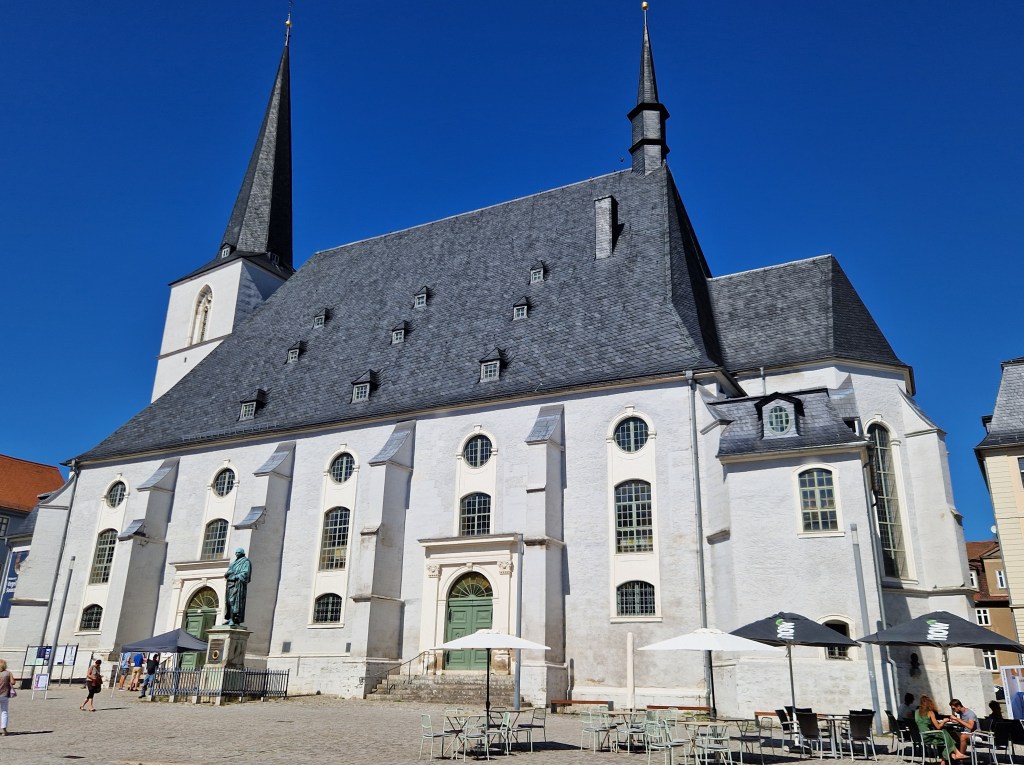
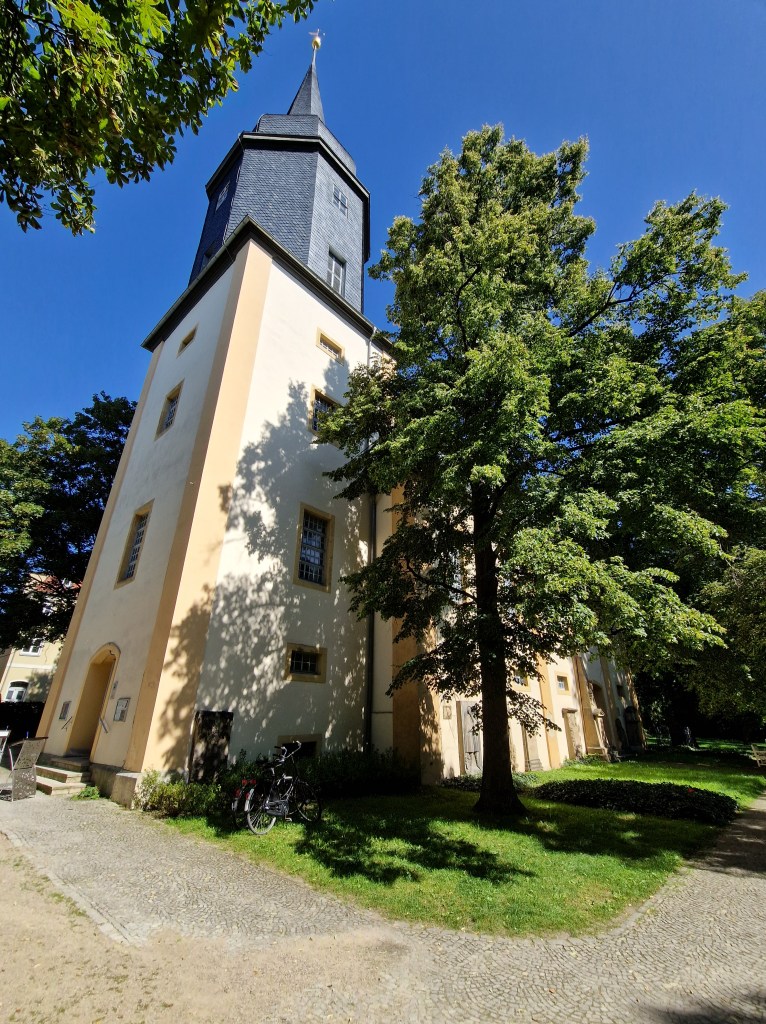
Having got that off my chest, I have to say that Weimar is a stunningly beautiful place. If nothing else, following Bach around Germany has taken me to amazing places that I would never have thought to visit. I realise that I did see these places in their best light, literally, with warm late summer sunshine; however, the preserved historic centres and magnificent churches would warrant a visit in any weather. It is about a twenty minute walk to the Weimar Marktplatz from the Hotel Kaiserin Augusta, and on the way you pass St. Jacob’s Church (Jacobskirche). This was in such disrepair when Bach arrived in Weimar that the Duke had it rebuilt in 1713, with a new tower on its old walls. Bach participated in the consecration ceremony and would have played the organ, which still has the original case. A bit further on you come to a square in which stands the large Town Church of SS Peter and Paul (Stadtkirche St. Peter Und Paul). This is another magnificent Gothic building, built between 1498 and 1500. In Bach’s day this was the primary ‘Town Church’, and five of Bach’s children were baptised here. Bach would have practiced and given lessons on the organ here between 1712 and 1714, whilst the court chapel (Himmelsburg) organ was being renovated. None of this is noted in the Church; however, another prominent academic, Gottfried Herder preached here (1776 to 1803), and of course there is a large statue of him outside. Locally it’s even called the Herder Church.
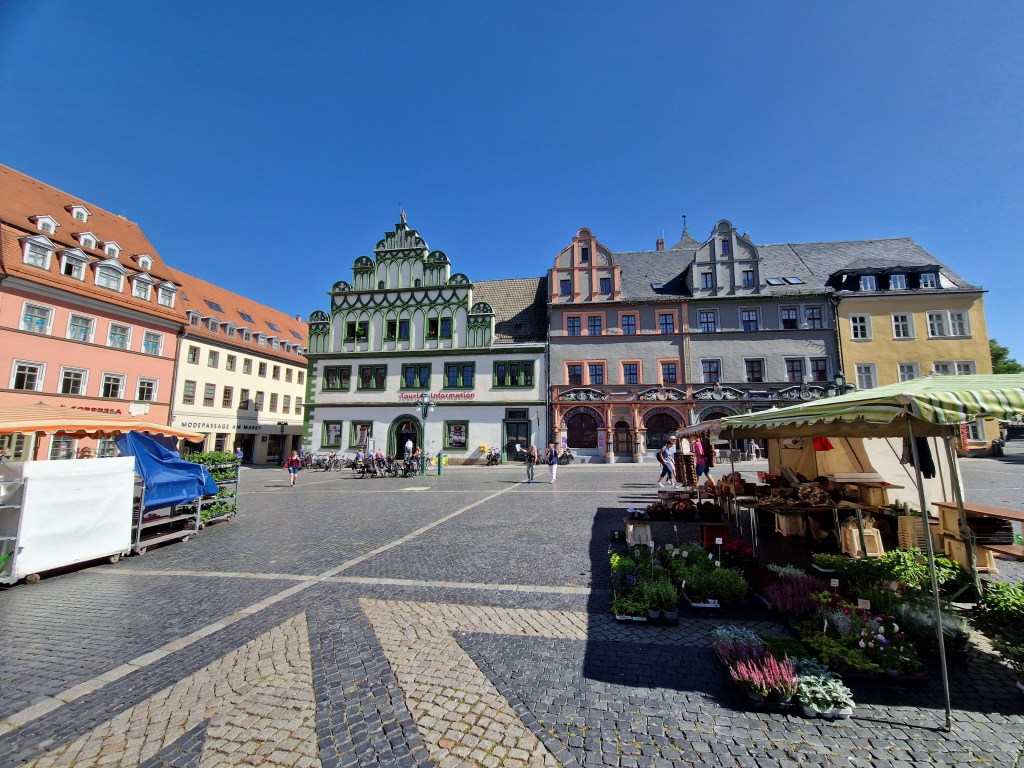
A short walk south takes you to the Marktplatz, which is a lovely open space surrounded by historic buildings. When I arrived, it was full of little market stalls selling local produce. My attention was drawn by the smell of the local ‘delicacy’, Thüringer Sausage, being grilled over charcoal. It is a typically meaty German sausage compared to traditional British sausages, but it does have a distinctly spicy flavour. It is also low in fat, so after this first sample, it became my staple for lunchtimes whilst in Thuringia.
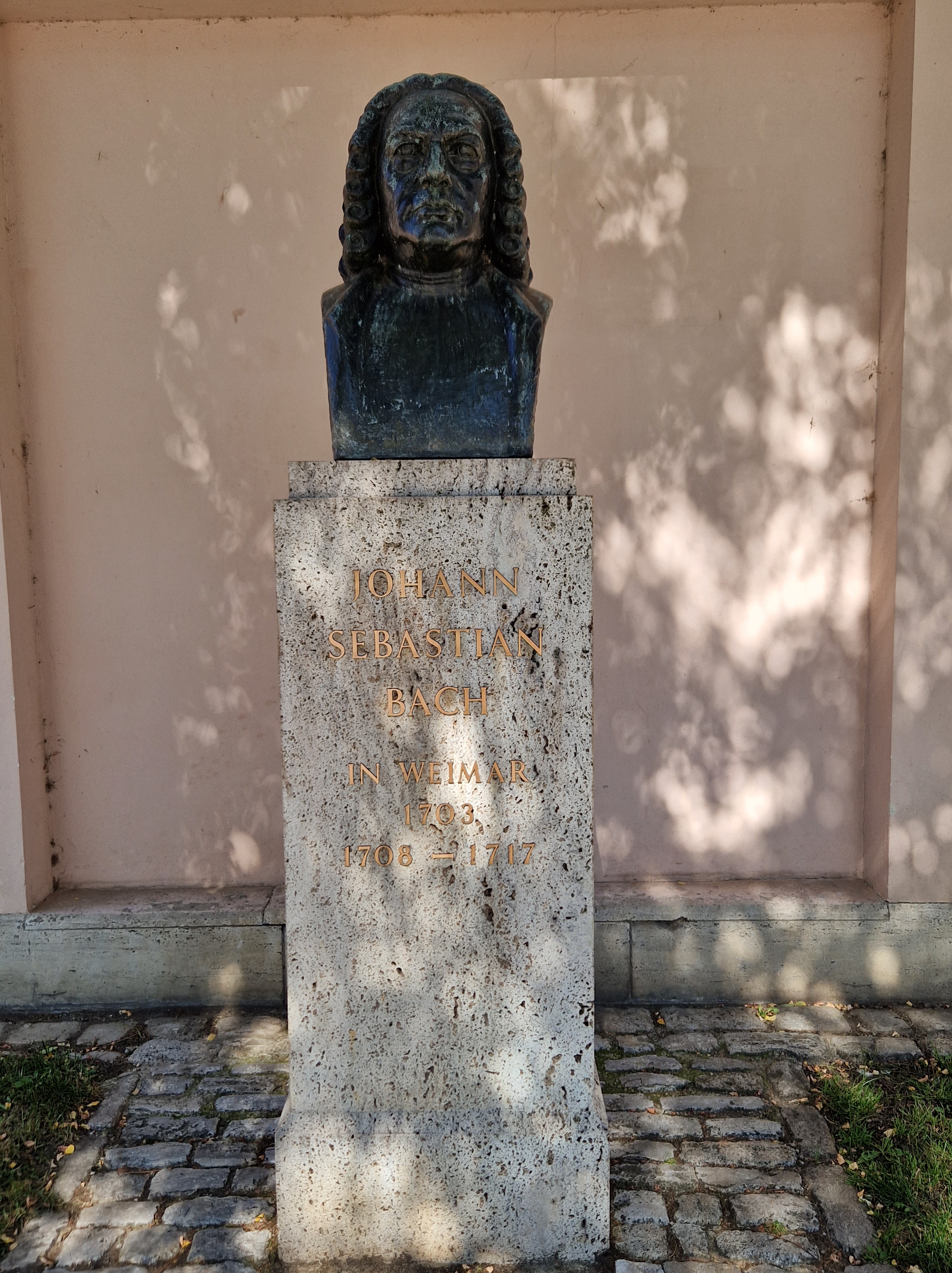
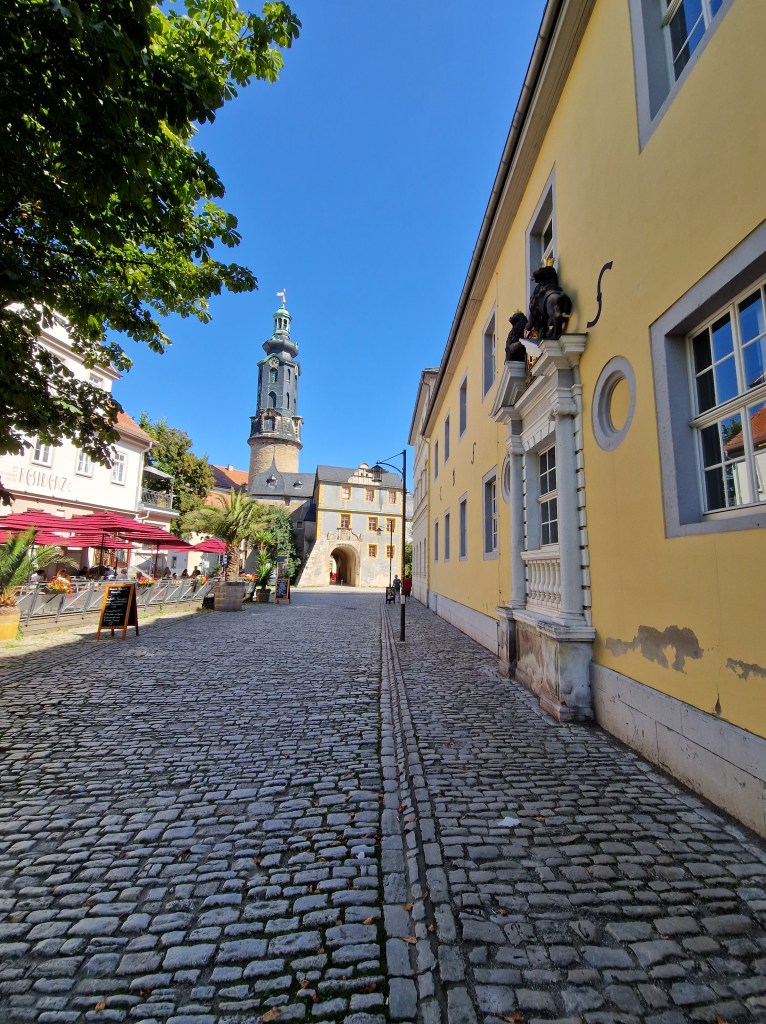
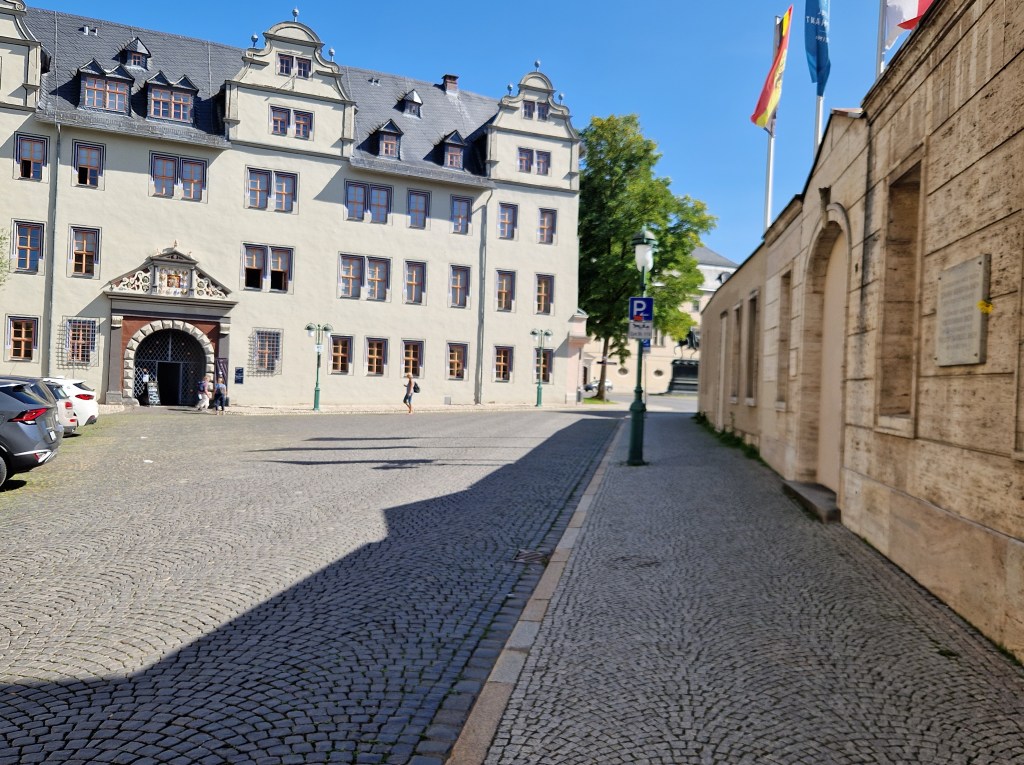
If you look East from the south side of the Marktplatz you can see the Red Palace. I don’t wish to spend too much time on the ducal setup in Weimar, but to understand the difficulties Bach had to navigate I will try to summarise for those not familiar with this strange arrangement. Weimar had a coregency, with two rulers. Bach was employed by Duke Wilhelm Ernst, and his coregent was his nephew Duke Ernst August. The problem was that Wilhelm didn’t get on with his original coregent, his brother, Johann’, who died in 1707, and this hatred extended to his son, Ernst August. Duke Wilhelm lived in the main castle, the Wilhelmsburg and Duke Ernst August lived in the Red Palace, a stones throw from the castle. It gets a bit complicated as Duke Johann, Ernst August’s father, remarried after the death of his mother in 1694 and the new wife was was given the Yellow Palace, which abuts the Red Palace, to live in, along with her son, prince Johann Ernst. Unfortunately the Wilhelmsburg was destroyed by fire in 1774, with nothing remaining apart from the gatehouse, known as the Bastille. The outsides of the Red and Yellow Palaces, however, are as Bach would have known them, although the interiors have been modernised. If you know where to look, you will find a small, weathered bust of J.S. Bach against the end wall of the Red Palace.
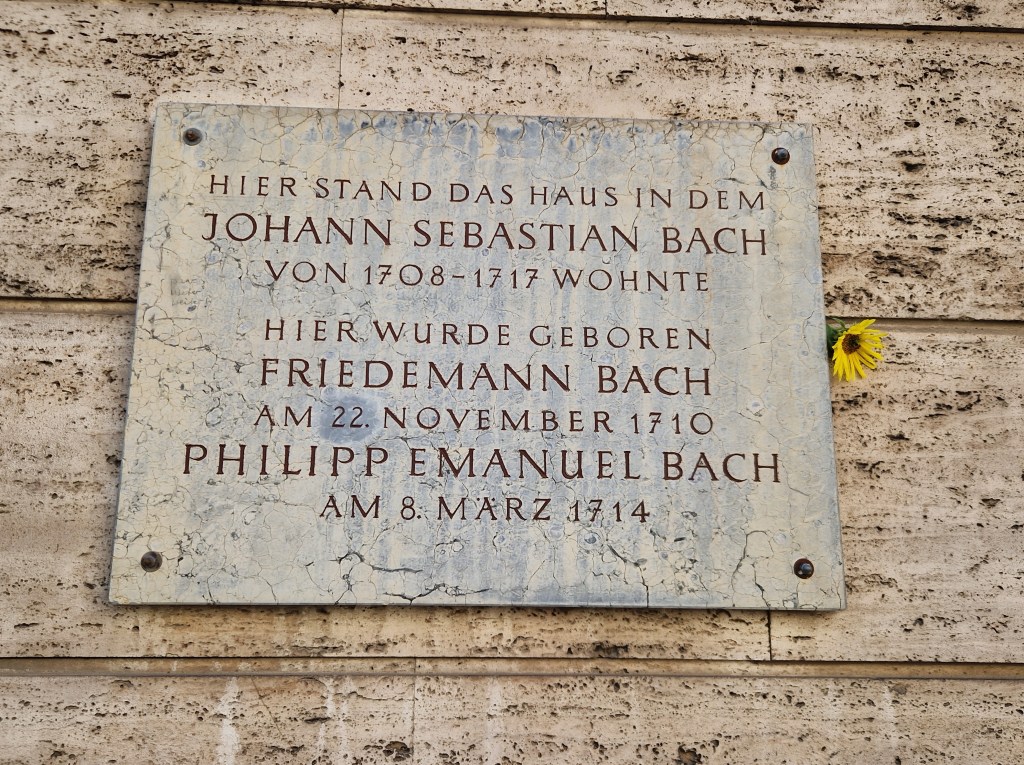
The street on the south side of the Marktplatz, in close proximity to the Red Palace, was where Bach lived (at Markt 16) during his time in Weimar. The only part that remains is a portion of the front wall, and this has a small plaque mentioning Bach and his first two most famous sons, although his first six children were born here. Bach would have had a short walk to work in the Wilhelmsburg, through the gatehouse, and even shorter walk when attending the Red and Yellow palaces. The Bach home was incorporated into the Hotel Elephant, but was severely damaged in an air raid in 1945. It was not completely demolished until 1988/89, which seems to have been a destructive act by the East German Government, just months before the fall of the Berlin Wall. The underground foundations and cellar survived, and have now been given UNESCO Heritage protection. There is a group, ‘Bach in Weimar’, that aims to rebuild the house on the original foundations; however, presently it doesn’t seem like they have political support, or indeed any money, and so I am sad to say that Bach’s Home in Weimar is likely to remain a hotel parking space for the foreseeable future.
The Weimar period had a huge influence on Bach’s musical development. The young Prince Johann Ernst, who lived in the Yellow Palace (half brother of Duke Ernst August, who lived in the Red Palace), was a talented musician. Bach had been a teacher and mentor to Johann from the time he first arrived in Weimar. As mentioned, Bach’s employer Duke Wilhelm hated his nephew and coregent, Duke Ernst August, and this extended to his immediate family; even banning his staff all contact with the other court. Bach, of course, ignored this directive and continued teaching and playing music in the Red and Yellow palaces. Johann spent some time in the Netherlands, and returned with so many concerto scores that he had to build a new section of his library. Much of this music was from Italy, particularly music by Vivaldi, Albinoni and Corelli. These had a profound effect on Bach, as he studied them intensively, and transcribed many into keyboard works. He also transcribed music by the young prince, which was also written in the Italian style. Bach’s approach to music up to this point had been founded in a Germanic counterpoint and dense texture tradition, which was very different to the Italians love of melodic writing, clear harmonic structure and distinctive solo voices. After this study, Bach began to produce instrumental music (e.g. the Brandenburg Concertos) and cantatas (e.g. Himmelskönig, sei willkommen, BWV 182) that fused the German and Italian styles.
Although slightly off-track, I can’t resist telling a story from Bach’s last year in Weimar. He visited the court in Dresden, more than a hundred miles from Weimar, as this had a thriving musical scene. The court had recently engaged the French keyboard player Louis Marchand, who was famous across Europe for his virtuosity. When the great German musician arrived, the court decided to have a public French vs German duel (probably on harpsichord and organ). Marchand apparently heard Bach rehearsing (some suggest he was playing his great Toccata and Fugue in D minor, BWV 565) and lost his nerve (who wouldn’t!). On the night of the contest, Bach was left waiting patiently at the keyboard, and so they went looking for Marchand, only to discover that he had ‘done a runner’ and slipped out of town at dawn. Bach gave a virtuosic performance to the assembled dignitaries and was announced the winner by default. There is a bit of a twist though, as the servant in charge of the prize money also ‘did a runner’ and Bach missed receiving the equivalent of two years’ salary. Bach’s fame did spread rapidly after this, with Germans enjoying a musical victory over the pride of France; however, his reputation was being built as a performer rather than a composer.
Bach’s employer, Duke Wilhelm has been widely portrayed as a difficult person, who retained his animosity towards his brother and his nephew for decades, even refusing to visit his younger brother on his deathbed. Bach was not always successful in maintaining good relations with the Duke, and this relationship certainly deteriorated towards the end of his tenure; however, for long periods in his employment Bach was encouraged to express himself musically. Duke Wilhelm was also a devout Lutheran, and appreciated not only Bach’s talent, but also his ambition to regulate and improve the music of the church. Bach was given regular pay-rises, and had access to a fine band of professional instrumentalists and singers. Unfortunately much of his chamber music from this period is lost, but most of his known organ music derived from this period. After Bach let it be known that he was considering a position in Halle, he was given the title of Concert-Meister in 1714, and another pay-rise. This role meant that Bach had to produce new monthly works for the church, which led to a wonderful series of cantatas. It is strange, therefore, that when the position of court kappellmeister (director of all court musical activities) became available in December 1716, the Duke overlooked Bach and gave the position to the less talented vice-kappellmeister (after already offering it to Telemann). Although Bach remained in Weimar for another year he stopped producing the monthly cantatas.
Bach continued to visit the coregent Duke Ernst August and his family, even after the untimely death of the talented Prince Johann at the age of nineteen in 1715. This friendliness didn’t go down well with Duke Wilhelm, and his vexation increased when Bach was offered a position by Prince Leopold of Anhalt/Cöthen (Köthen), who’s sister had recently married the hated Duke Ernst August. Bach’s request for dismissal was refused, and presumably Duke Wilhelm thought that was the end of the matter. As we know, Bach could be stubborn, and re-petitioned for dismissal several more times, until the Duke thought him insolent, and sent him to prison. A possible location for his detention was a cell in the Gatehouse (Bastille), which has a window on the left side, half-way up, when viewing from the Marktplatz. After a month he was released, and was sent packing to Köthen. I suppose we can thank Wilhelm for depriving Bach of his liberty, as during this time in isolation he started on the monumental work, The Well-Tempered Clavier – preludes and fugues in every major/minor key, which are recognised as being a cornerstone of western classical music literature. The things you will do out of boredom!
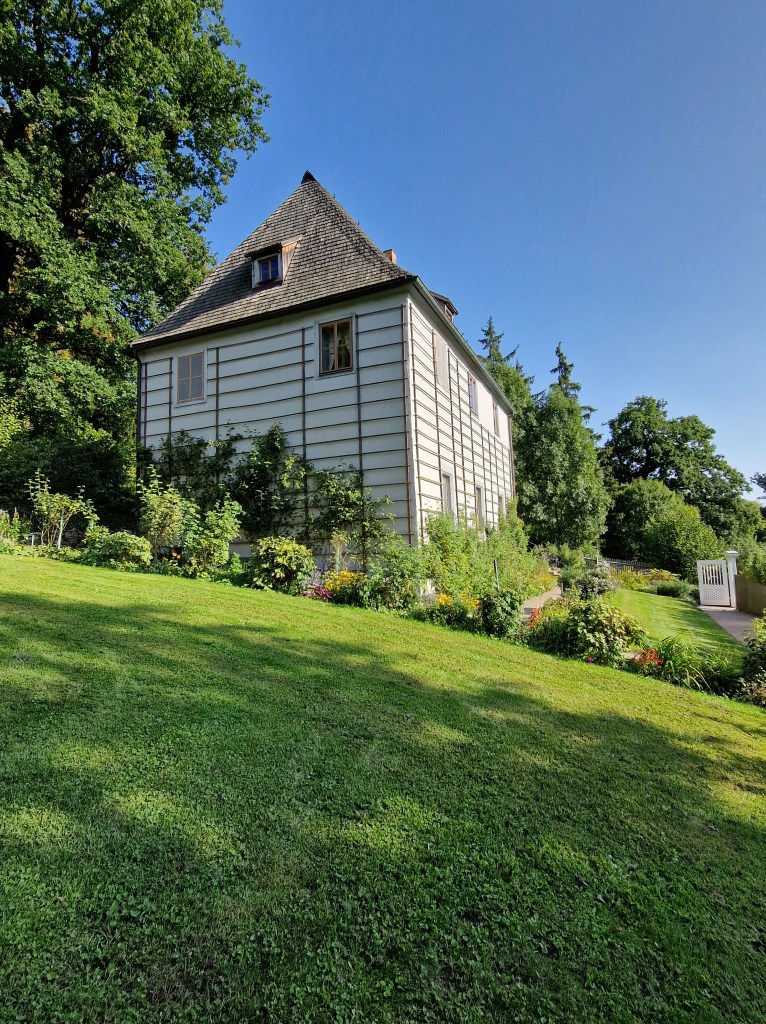
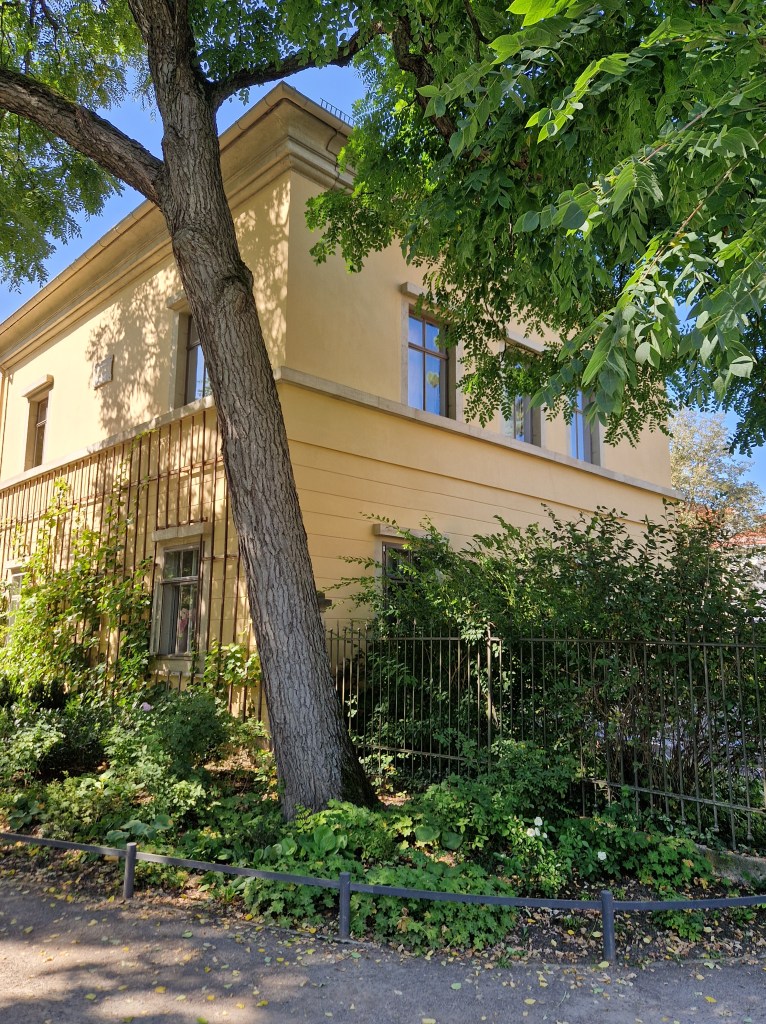
Even though Weimar has done little to recognise one its greatest residents, I have to admit that it is a lovely place to visit. From the historic centre you can take a short walk into a beautifully landscaped park (Park an der Ilm), which was designed as an English garden by Goethe, and straddles both banks of the river Ilm. In the park, you can visit Goethe’s garden house and the Liszt House, then stroll through the wide tree lined avenues running along the river. For those interested in German literature, there are museums dedicated to Goethe, Schiller and Nietzsche (plus a number of large statues!). My final task in Weimar was to find a fridge magnet for my collection. There was not a chance of finding one related to Bach, so had to search hard for one that didn’t have the face of one of the literary ‘greats’ plastered on it.
Weimar
Köthen (11th-13th September)
Getting to Köthen by train from Weimar was a little more convoluted, having to change trains at Erfurt and Halle. It still should not have taken longer than two hours; however, unusually for German trains, the train got stuck outside Halle station for 20 mins, meaning I missed the connection. I therefore had an hour to kill in Halle, and did think about a quick walk in the city; however, the station area was very busy, and Halle seemed to be such a large city, so I grabbed some lunch and sat in the sunshine on the platform.
Bach visited Halle a couple of times from Weimar to advise on the organ construction at the Market Church of Our Lady. In 1719 he again travelled to Halle, this time from Köthen, with the intention of meeting Handel, who was visiting family. Handel had left the city only a few hours before Bach arrived, which was not only a disappointment for Bach, but also for all music lovers! Apparently, the competitive Bach wished to ask the ‘world-famous’ Handel to take part in a keyboard challenge. Now that would have been something!
The scenery changed dramatically between Weimar and Köthen. The rolling tree-lined hills of Thuringia gave way to a flat landscape, with lots of wind farms. The towns also appeared to be more industrial. I was really excited about this leg of my trip, as I do like Bach’s instrumental music, and many of my favourite pieces were written in Köthen. I stayed at the Hotel Anhalt for two nights, which was a ten-minute walk from the station. I dropped my bags and headed for the central market square. The city had a different feel to those visited so far in Thuringia. It suffered a lot of damage during World War 2, mainly around the small airfield. In 2008, Germany’s largest concentration of unexploded bombs were found in the surrounding area.
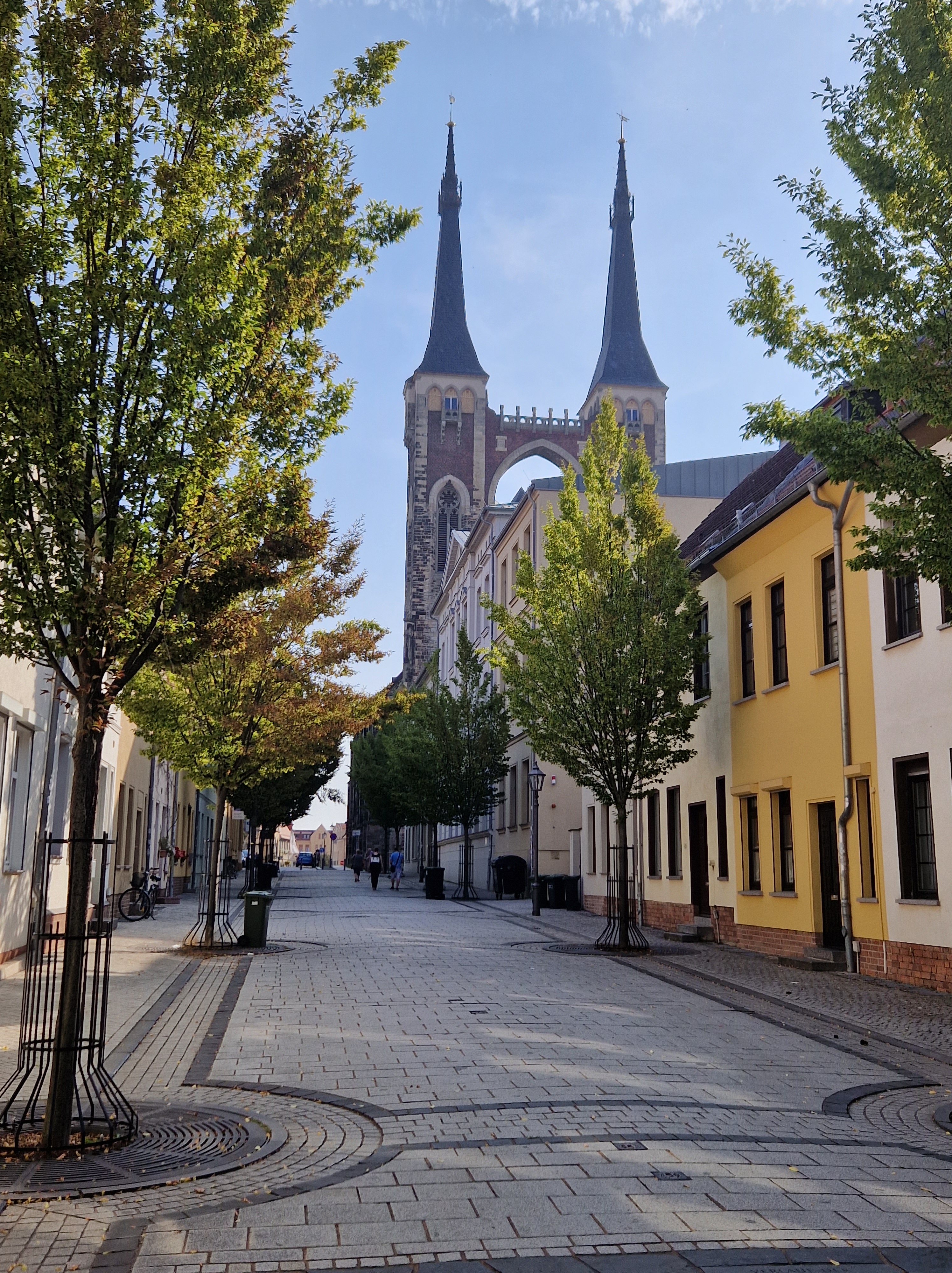
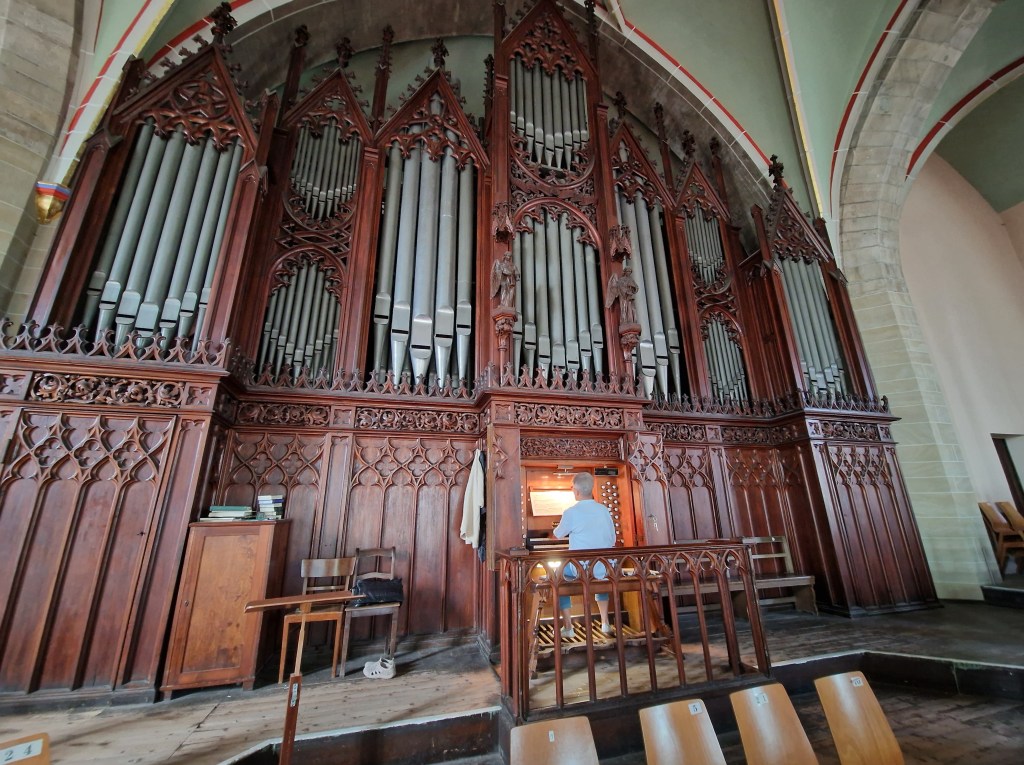
Fortunately, the historic sites were not overly damaged, and St. Jacob’s Church still looks magnificent, sitting in the large market square. This church dates from the early sixteenth century, but the Köthen landmark twin spires were not added until the nineteenth century. In Bach’s time, this was the town (and court) Calvinist church. A famous large organ by Friedrich Ladegast was installed in 1877, which I thought would be worth seeing. A church official kindly let me up to the organ loft, where I met a lovely lady who was about to begin playing. She seemed a bit surprised to see me up there, but after I told her about my trip, she said she would play some Bach for me. This became one of the highlights of the trip, standing next to a famous organ, with Bach fugues resonating around this ancient building. The organist informed me that she was giving a recital later that day, which, of course, I attended. Even from the pews, the organ sound was still splendid. The standout piece for me in the recital was surprisingly not by Bach, but by his hero, Dietrich Buxtehude, which I had not heard before. On leaving the church, I noticed a little stand of CDs. Unfortunately, no Bach (or Buxtehude), but I did pick up a CD of Liszt organ works, played on the Köthen Ladegast organ by Martin Haselböck.
Köthen in Bach’s time was relatively small, with a population around three thousand. Bach’s employer in Köthen, Prince Leopold, was twenty-three years old when Bach arrived (at the age of thirty-two). He had a lively mind and had a genuine passion for music. He was a Calvinist, and so would not require Bach to produce music for the church. In fact, his interest was in instrumental music, and he employed a talented group of 15-20 musicians, which Bach had at his disposal. Unlike his relationship with Duke Wilhelm in Weimar, there was a personal affection between the Prince and Bach, which continued even after Bach left for Leipzig. The Prince was an excellent bass singer, but his passion was for the violin, the viola da gamba, and the clavier— which he was reportedly a ‘reasonably good performer’.
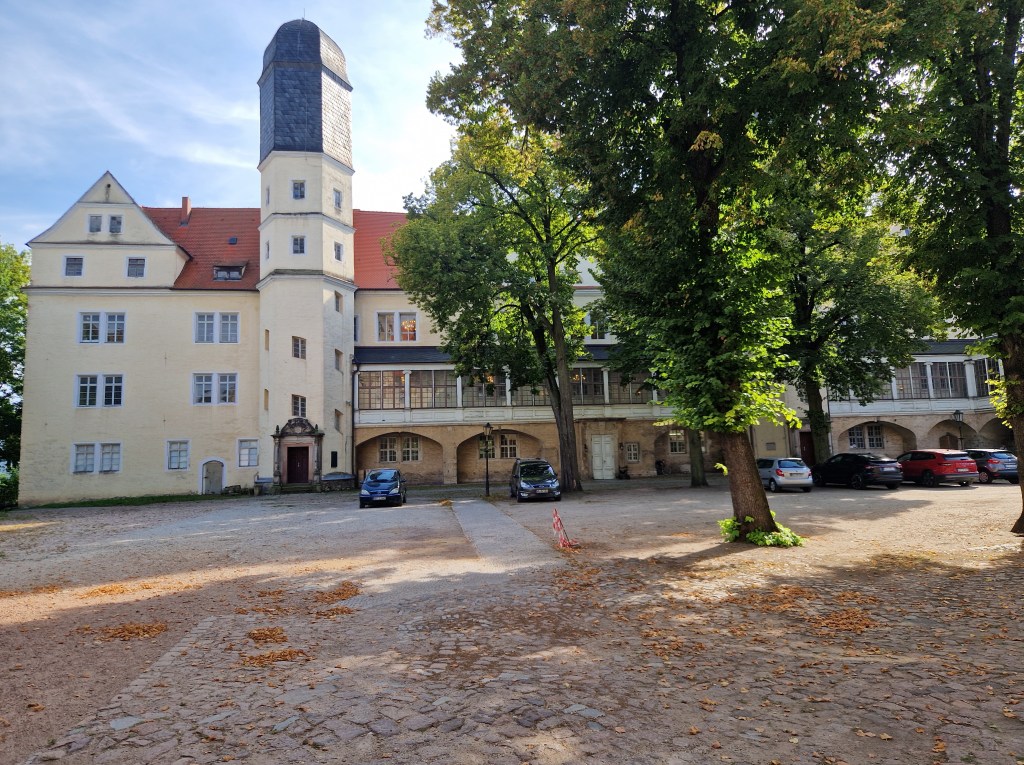
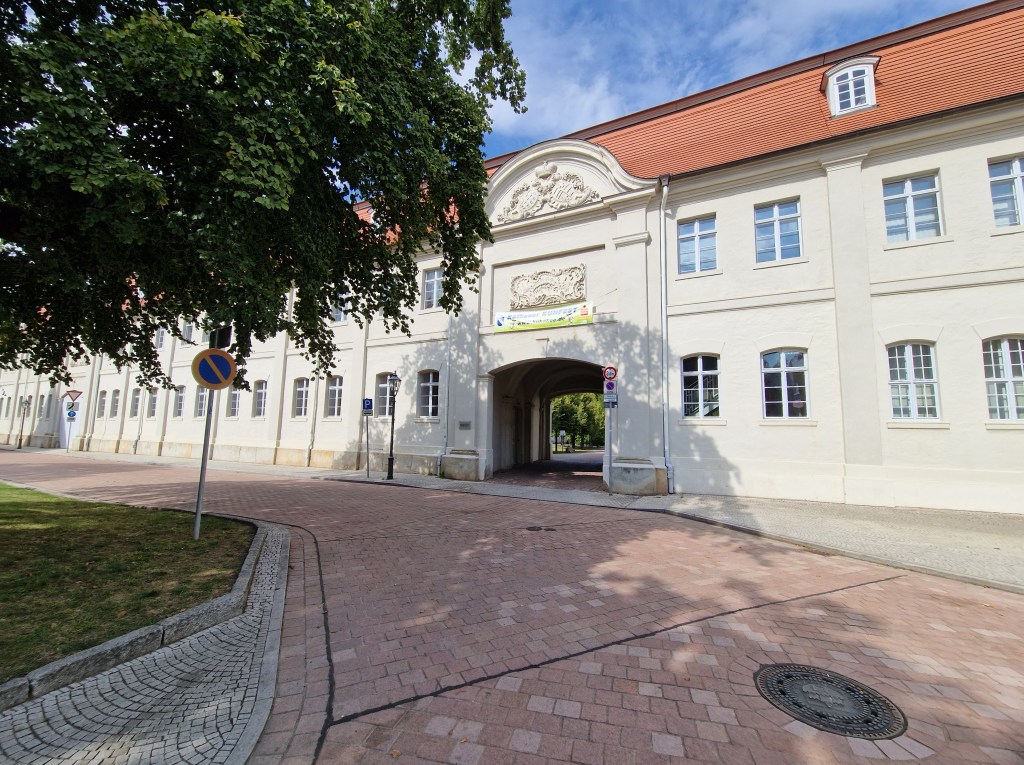
I was anxious to visit the court Palace (Schloss), as this was a place to get close to where Bach worked. On arrival, I walked past the very smart-looking indoor riding hall (now a conference centre) and stables (now a music school), into the courtyard. I have to admit that I was a bit disappointed with the appearance of the Palace Residential wing, and even more disappointed with the rather shoddy-looking second wing, which now holds a range of non-musical exhibits. It seemed that they had missed out on the renovation that was afforded to the stables and riding hall. I was to be further disappointed when I got to the museum door, finding that it was closed until Wednesday, the day I was supposed to be leaving Köthen. I sloped off to the park that surrounds the Palace, found a bench, and put on Bach’s Cello Suites on my headphones. Listening to this music outside the palace walls, I decided I couldn’t leave Köthen without seeing the place where these masterpieces were first performed. I changed my train booking for Leipzig and gave myself the morning on Wednesday to explore the Palace museum.
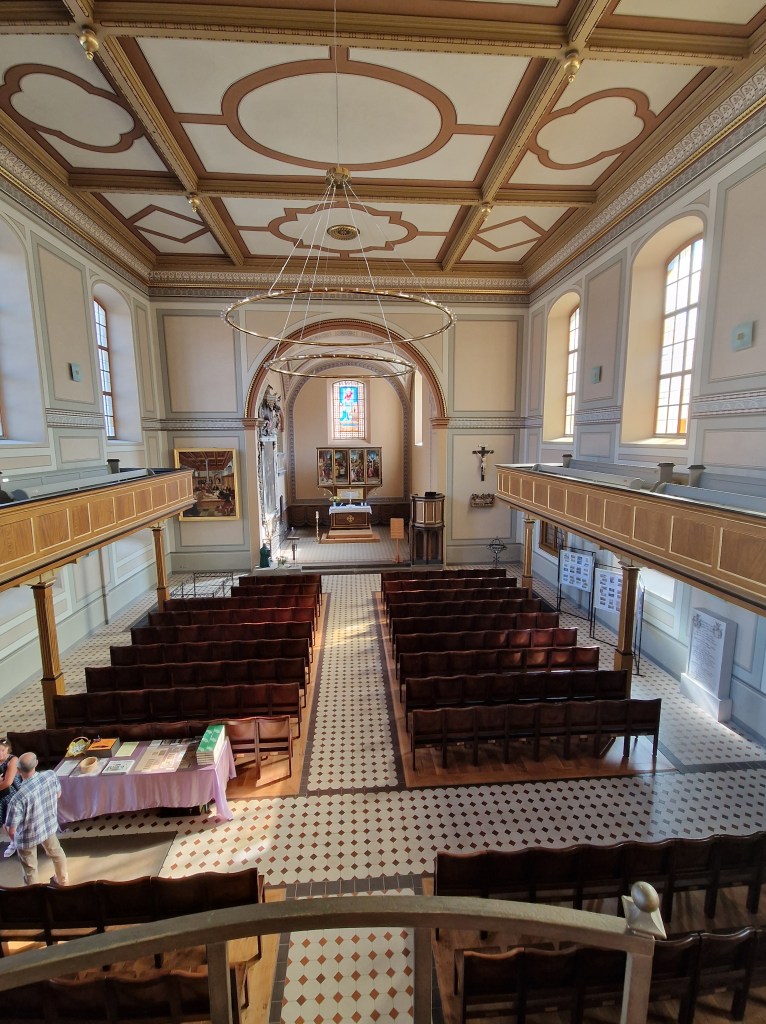
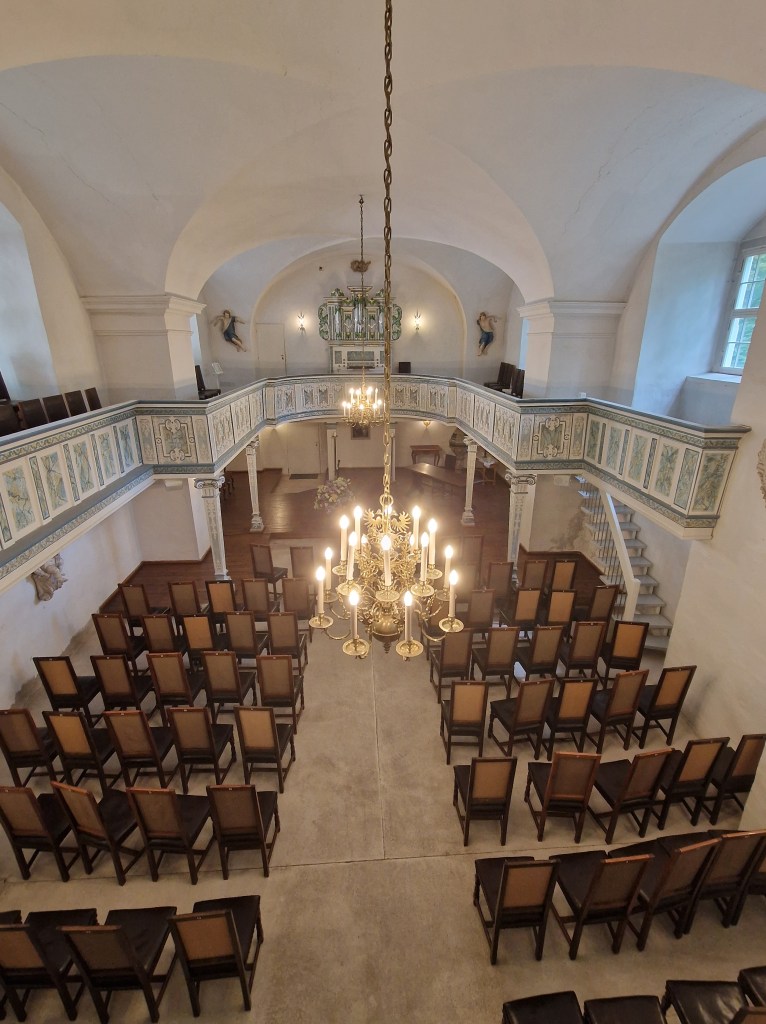
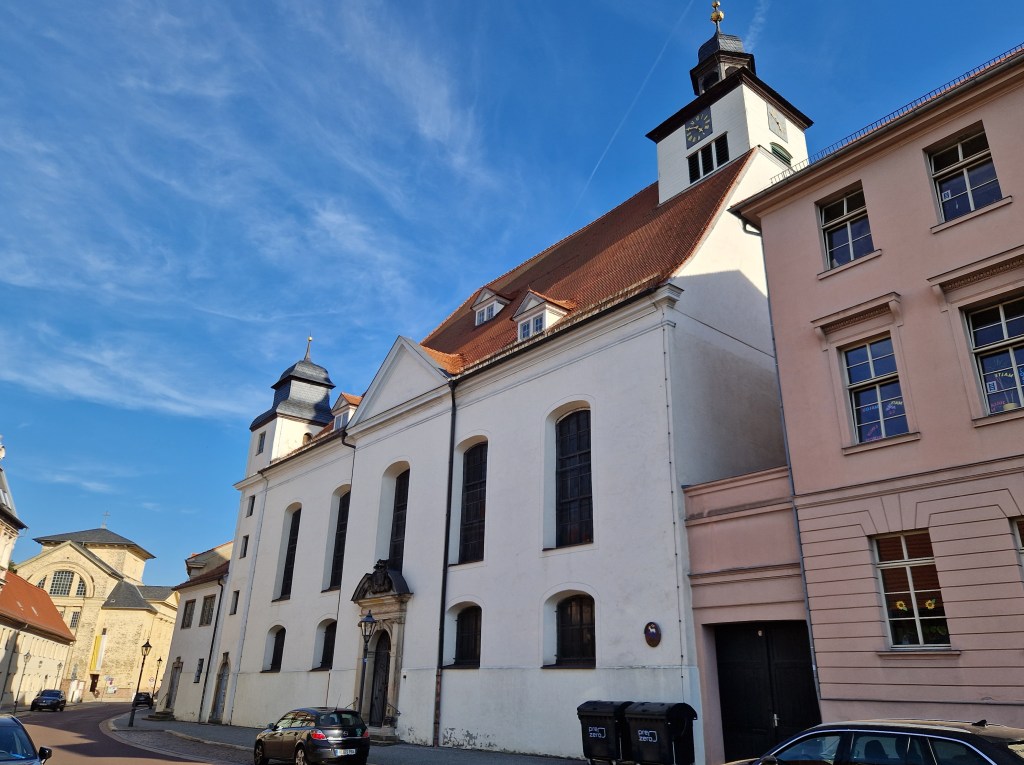
On Tuesday, I wandered around the city streets and visited the zoo, which is small in size and seemed a little run down. In the afternoon, I ended up at St Agnus’s Church, which in Bach’s time was the Lutherans’ place of worship. Prince Leopold’s mother was a Lutheran, and her husband had granted Lutherans complete religious freedom in this Calvinist domain. Bach would have attended this church with his family, sung in the pews, and occasionally played the small organ. Although built for a religious minority and lacking a spire, the interior is very similar to the simple Baroque-style churches in Thuringia. A large painting of Leopold’s mother, Princess Agnes, hangs near the altar. Prince Leopold died in 1728 at the age of thirty-three, with his mother outliving him by twelve years.
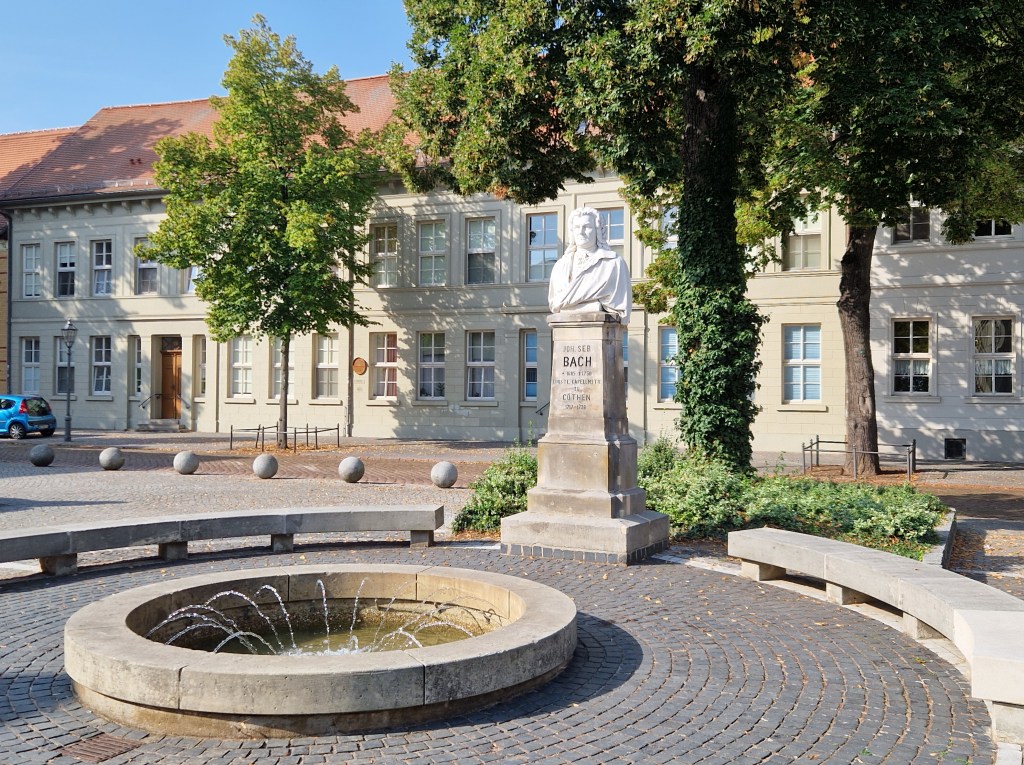
There are not many other Bach-related sites in the city; however, it is believed that he moved into a newly built residence in 1719 (likely to have been his second in Köthen), which still stands at Wallstraße 25/26 (now a private residence). In front of this, in a small square (Bachplatz), is a bust of the composer. There was one final house I wished to find, and this was the residence of Christian Ferdinand Abel, who was a court gamba virtuoso, and therefore, presumably, was the first to play the Cello Suites. The house stands close to the Palace at Springstraße 8, and is now an old-people’s home. It is probably most venerated by the local population as the place where Abel’s son was born, Carl Friedrich (1723-1787), who became an even greater gamba virtuoso than his father, and a significant composer.
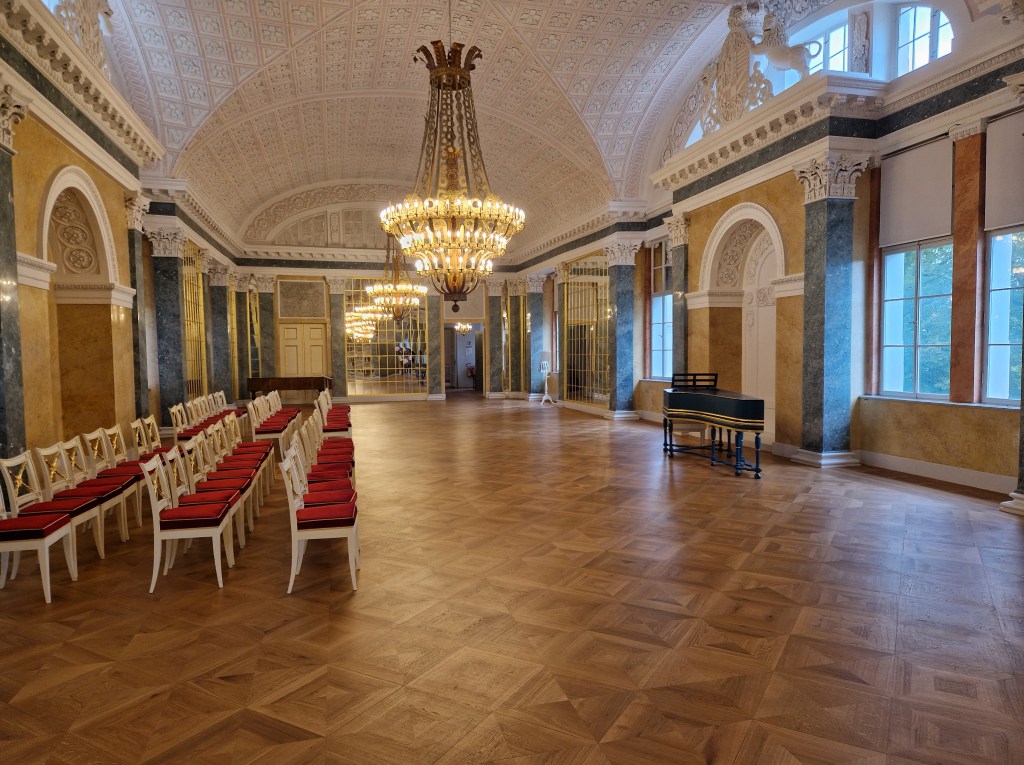
On Wednesday morning, I headed for the Palace again. Fortunately, the interior of the Palace is very well maintained, and the museum allows you to visit the Grand Hall on the third floor, where formal concerts would have been held. This was beautifully renovated in 1822, and it is not hard to imagine the court orchestra, being led by Bach, playing for the Prince and his guests. The other four rooms in the museum were those originally occupied by the Princess, on the second floor. One of these rooms is called the Bach room, and contains many musical instruments from Bach’s time, including a replica of the harpsichord that Bach personally escorted back from Berlin, where it is believed he met the Margrave of Brandenburg. There is also a small palace chapel that was used by the Prince and his family. All court employees were required to have their children baptised here, and Bach’s only son, born in Köthen (Leopold Augustus), was baptised in the chapel in November 1718, with Prince Leopold being one of the godparents. Unfortunately, the child died less than a year later. In the museum shop, on the way out, I found a double CD of the Bach Sonatas and Partitas for Solo Violin arranged for Viola by Atilla Aldemir. I thought this would be an interesting listen, and when I read that it had been recorded in Köthen’s St. Agnus’s Church, it was a must have disc!
In 1720, Bach went on a court visit to Karlsbad with the Prince, as Prince Leopold always liked to travel with a small group of musicians. Bach returned to his home and received the horrific news that his wife had died suddenly a few days before, at the age of thirty-five, and was already buried. The cemetery where she was buried is now a small park/green space (Peace Park). On a stone monolith in Peace Park there is a plaque commemorating the life of Maria Barbara Bach. Eighteen months later, Bach married Anna Magdalena, the daughter of a court trumpeter at Weissenfels. Bach was indeed blessed to have had two successful marriages. Anna Magdalena was a professional singer at the Köthen court and on marrying Bach took on his four surviving children aged 13, 11, 7 and 6, which would have been a challenge for any twenty-year-old. She seems to have been a remarkable woman, managing Bach’s household for his remaining twenty-nine years, having 13 children herself (with six surviving into adulthood), and acting as Bach’s most reliable copyist. Nine days after Bach’s marriage, Prince Leopold married the nineteen-year-old Friederica Henrietta, who Bach described as being ‘opposed’ to music. The Prince was so infatuated with his new wife that he also seems to have lost his love of music. The Princess soon persuaded Leopold to dramatically reduce the ‘extravagant’ spending on musicians (it was a fifth of the entire court income). Although Bach was genuinely fond of the Prince, he took this change in direction as a sign to leave Köthen. He successfully applied for the position of the Leipzig Thomaskantor, and in May 1723, he left Köthen to move into his new quarters at the St. Thomas School.
I mentioned previously that Bach’s time in Köthen is of special interest to me. He appeared to revel in being employed by a young, enthusiastic music lover. He had a band of highly skilled musicians, with strong wind and string players, including a virtuoso viola da gamba player (Christian Abel) and an exceptional lead violinist (Joseph Spiess). These players inspired Bach to experiment and write music requiring exceptional virtuosity. We also have to remember Bach himself was a keyboard virtuoso and a very proficient violinist. It’s not always easy to date Bach’s works, but the pieces that are credited to this period include the Cello Suites, Sonatas and Partitas for Solo Violin, The French Suites, Brandenburg Concertos, Orchestral Suites (begun in Köthen) and The Well-Tempered Clavier Book 1 (completed in Köthen). I love the story about a committee, chaired by astronomer Carl Sagan, setup to decide what music from humanity should go on the two Voyager spacecrafts launched in 1977. One of the members suggested sending the complete works of J.S. Bach into space, but the committee thought ‘the aliens may think we are bragging’. As it was, three out of the twenty-seven tracks on the golden discs were by Bach, and two of these were from his time in Köthen: namely, The Brandenburg Concertos No. 2 and The Partita No. 3 for Solo Violin. I hope the aliens agree with me that this was Bach’s finest period!
Köthen
Leipzig (13th-16th September)
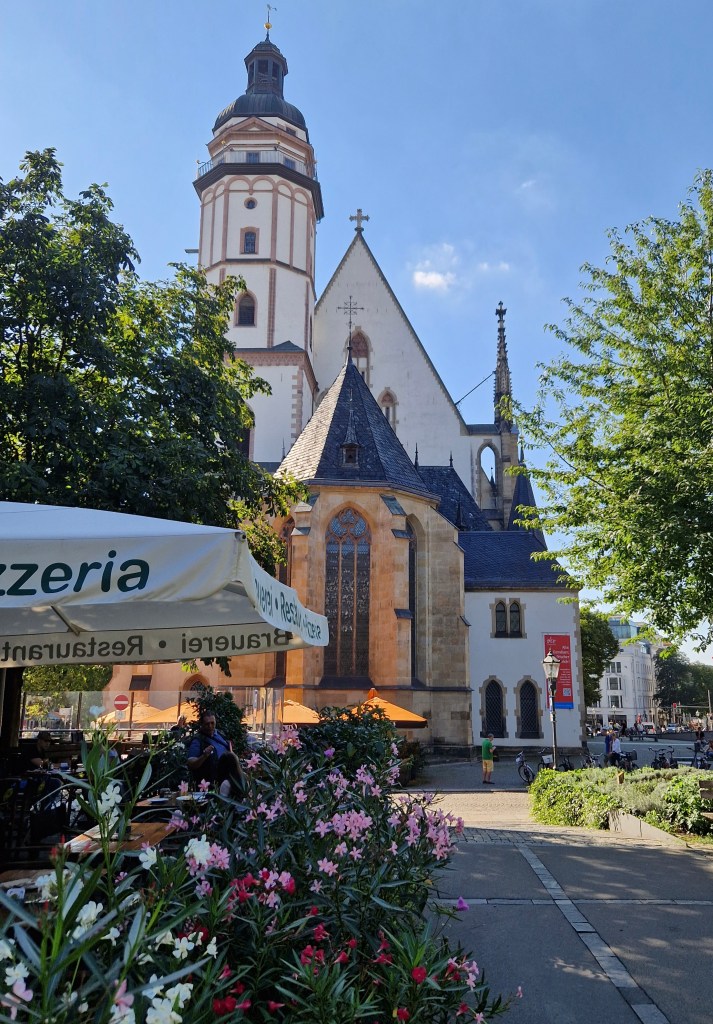
After spending the morning at the Köthen Palace, I embarked on the last leg of my Bach Pilgrimage by boarding a train in Köthen heading for Leipzig (via Halle). I realised I had arrived at a much larger city when I tried to navigate my way out of the huge central train station. The current population of the city is just over 600,000, and in Bach’s time it was a significant city of around 35,000 people. I booked three nights at the H2 Hotel, which is a modern hotel just outside the central station. After checking in, I walked into the city and after around 20 mins arrived at St. Thomas’s Church.
Bach was a little concerned about his move to Leipzig. The Thomas School Kantor ranked lower than his previous court Kapellmeister’s post, although Köthen was a tiny principality by comparison. He was now back to having teaching duties, working with school choirs and being a public servant. He would have around fifteen instrumentalists recruited from university students, who I can’t imagine were of the same calibre as his Köthen band. However, Bach would now be responsible for creating and shaping the church music for an entire city, which always seemed to be the underlying goal for his life in music. Bach would spend his remaining twenty-seven years in Leipzig, writing a huge amount of music, including around 200 cantatas, several passion settings, the B-minor Mass, Christmas Oratorio and a number of instrumental pieces. Bach lived at the Thomas School, and although his rooms were whitewashed and cleaned before his arrival, the building was old and neglected. It was thoroughly renovated in 1731/32, with two floors being added, and a new kitchen building. It also housed the other senior staff members, and around fifty boys. It sat in the square, next to St. Thomas’s Church and the Bose House, but was unfortunately demolished in 1902.
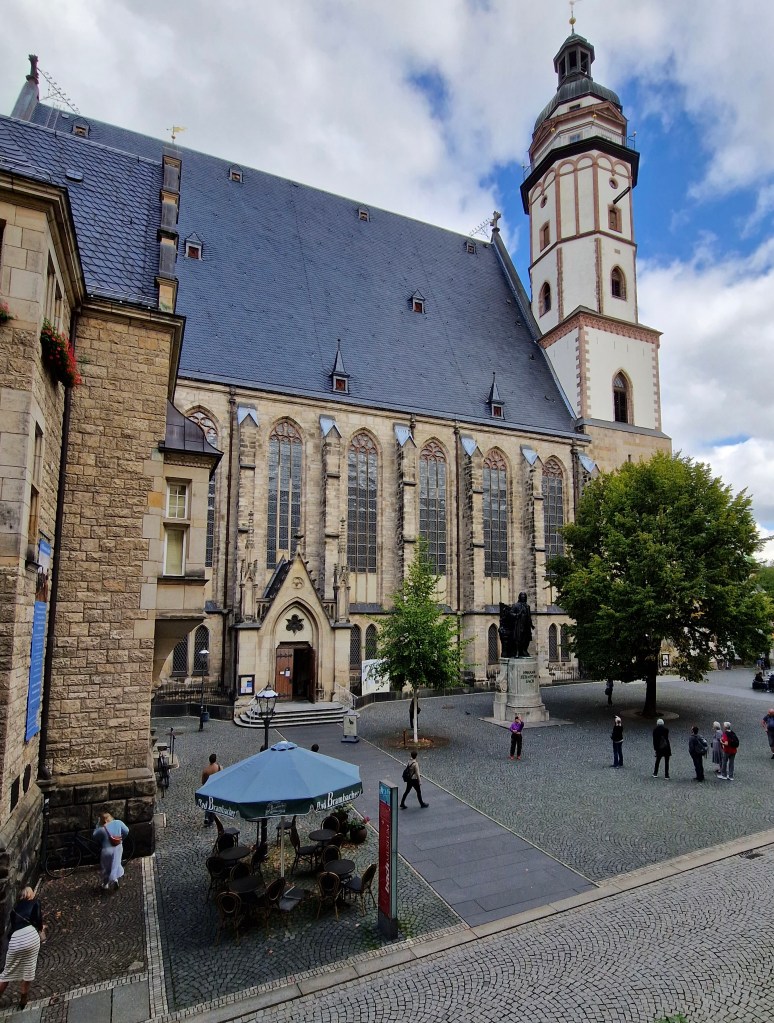
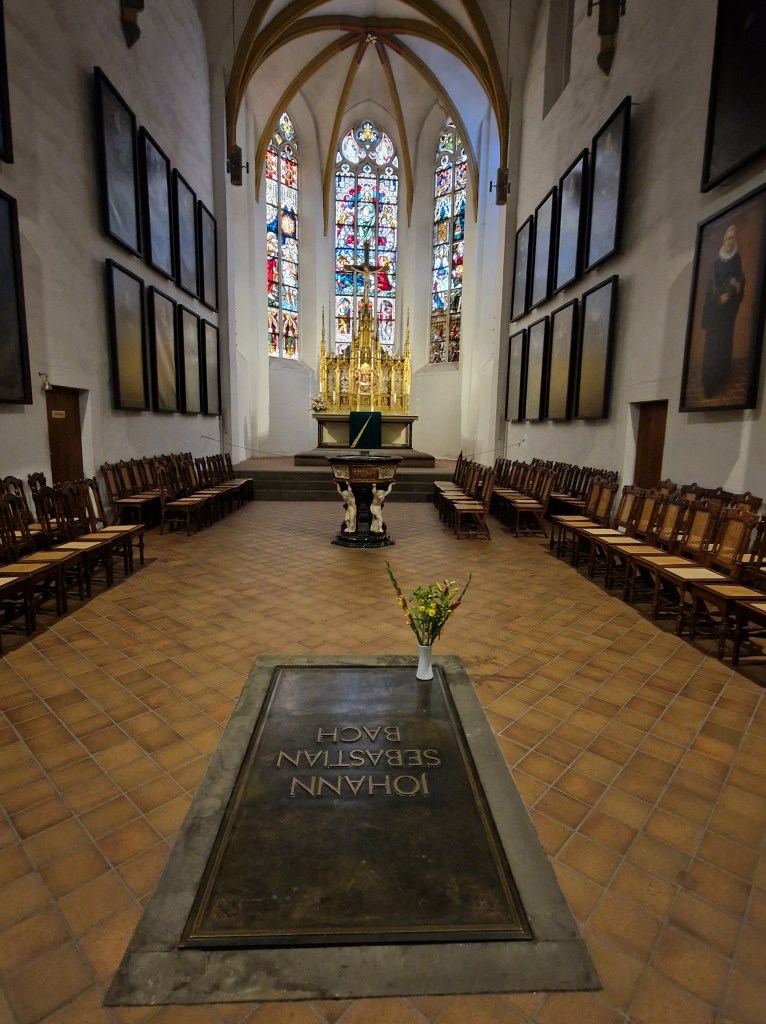
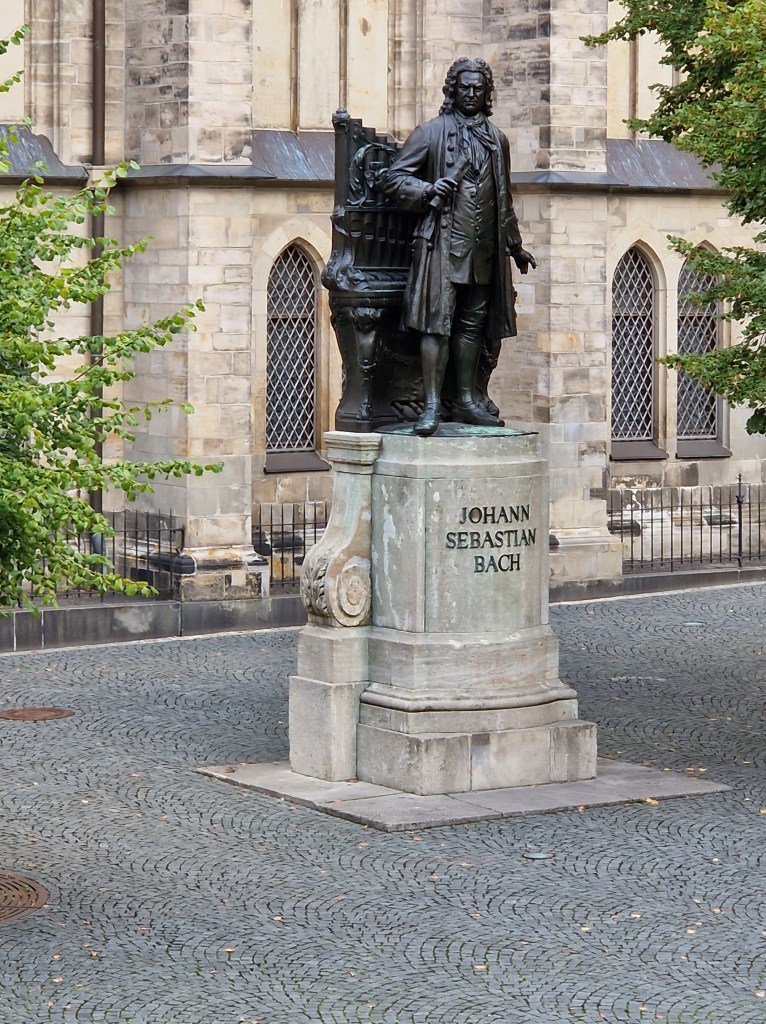
The St Thomas’s Church we see today dates from the late 15th century. The Late Gothic style interior has been restored to how it would have been when the church was consecrated in 1496, which is how it was when our old friend, Martin Luther, preached here in 1539. The only architectural change from this time was the addition of the tower in 1702. The tower was damaged by bombing in 1943, but fortunately the church was not severely damaged. The church underwent a major restoration following German reunification in 1990. This was completed on 28th July 2000 for the 250th anniversary of Bach’s death. Included in the renovation was the installation of a new Bach ‘replica’ organ, which can be found in the middle of the north balcony, opposite the Bach stained glass window. Almost reluctantly, I walked up the aisle towards the altar to view Bach’s burial tombstone. I felt like this marked the end of my journey, having followed Bach’s travels, from his baptismal font in Eisenach, to his final resting place in Leipzig. Bach was originally buried in the grounds of St. John’s Church. With the Bach revival, his remains were located in the cemetery in 1894 and placed inside the church. The church was destroyed in WW2, and his remains moved to St. Thomas’s Church in 1949 in a hand cart by the Master Mason Malecki, announcing to the superintendent “I bring Bach”. He has lain under a bronze epitaph in the church since 1950 (see photo below).
It was now early evening, and the Bach Museum across the square from the church was beginning to close. I did get time to pop into the museum shop to buy a programme, so I could plan my visit the following day. I was up early for breakfast in the morning, with the Hotel breakfast bar having a nice buzz, with lots of young people excitedly planning their day in the city, most of whom, I gather, were going to the zoo. I started to assume that every day would be like this one, sunny and warm – isn’t that just the norm for Germany in September? On the way to the museum, I couldn’t resist another view of St. Thomas’s Church. I was pleased I did, as when I arrived, someone was playing a Bach Fugue on the Bach organ, whilst being filmed by a camera crew. Another special moment, as I just sat down in the pews for twenty minutes, imagined Bach sitting up there playing, and enjoyed the sound of the organ swirling around the great hall chamber.
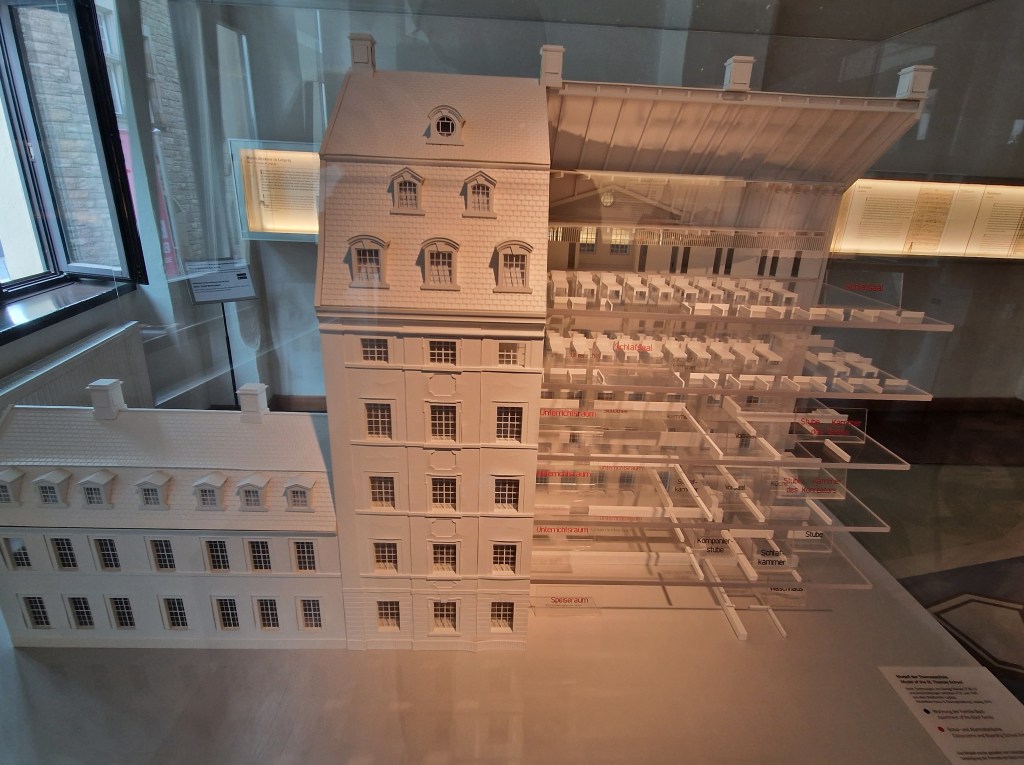
Bose House is the home of the Bach museum. It sits in the square opposite St. Thomas’s Church. It was formerly the home of the Bose family, who were prosperous merchants in Leipzig, and close friends of the Bachs. The museum hosts the Bach Archive, which was founded in 1950, and was finally turned into a non-profit corporation, with affiliation to Leipzig University. The museum has a very modern feel to it, with lots of listening stations. There is a small concert hall on the top floor, the “summer hall”, which occasionally hosts musical events. There is an interesting large Bach family tree filling one room, showing the extent of the musical family across Germany. A central exhibit is the original key-desk of the organ from St. John’s Church in Leipzig. Bach examined this organ when it was newly installed in 1743. I do like models, and there is an excellent scale model of the St. Thomas School, which details the rooms that the Bach family occupied, and gives an insight into the size of the building.
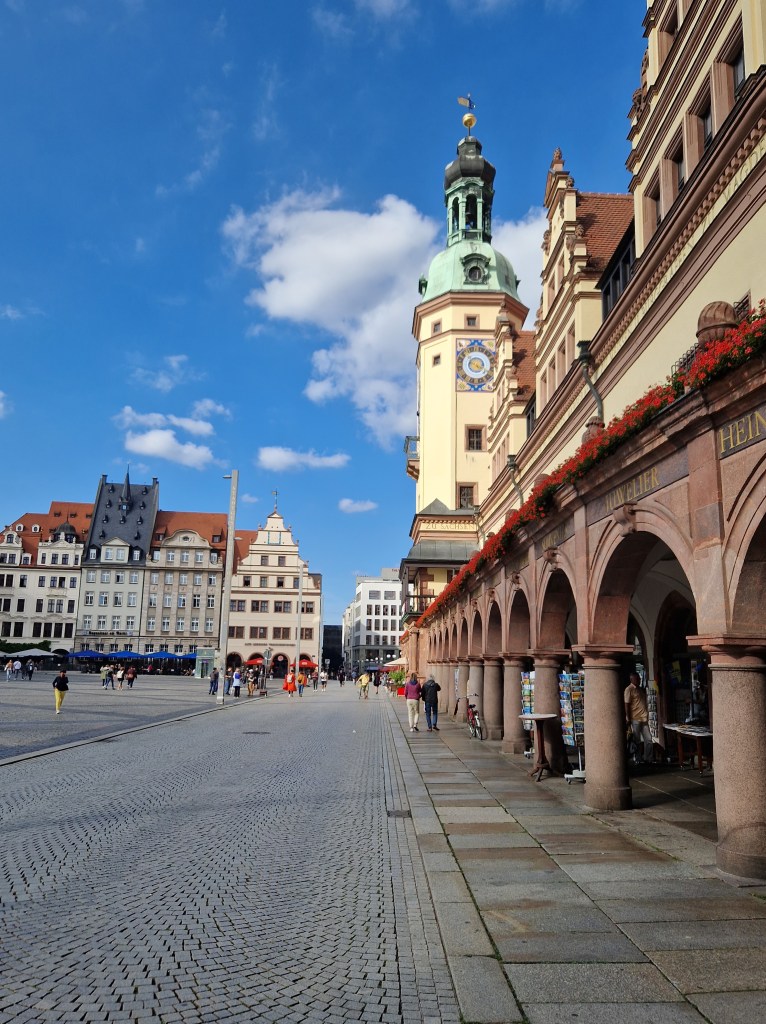
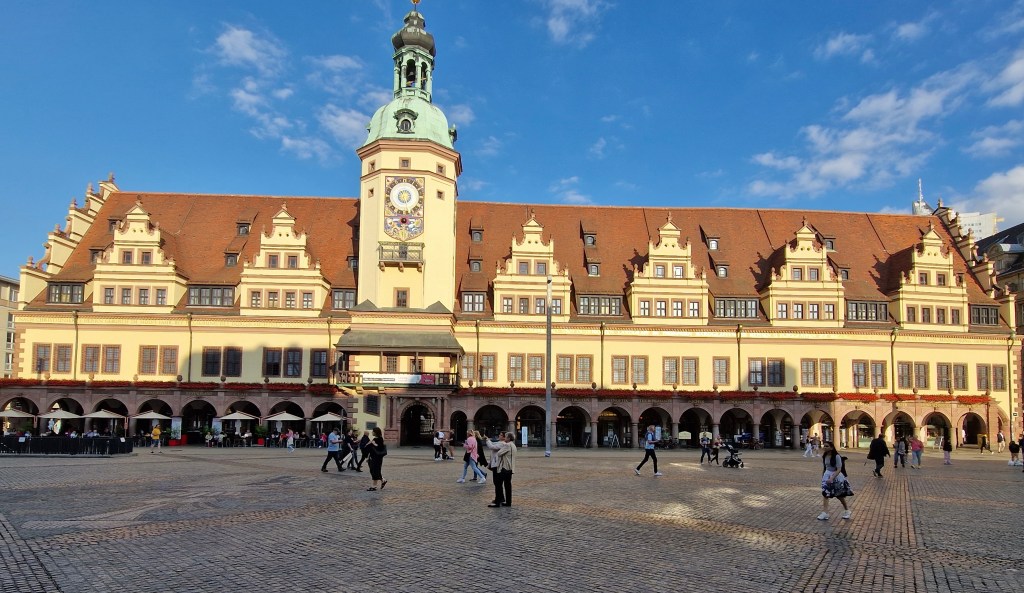
My next stop was the Town Hall (Rathaus). This building dominates the large central square. It was built in 1557, renovated in 1672, and largely rebuilt after World War II. It still has the table on which Bach signed his employment contract. The excellent Leipzig City Museum is also housed in this very large building. It has the earliest surviving version of the famous oil portrait of Bach, painted in 1746 by Haussmann. There is also a large exhibit showing Leipzig during WW2. I couldn’t believe the extent of the damage to the city, with one photo showing women and children standing, literally shell-shocked, in acres of rubble, whilst Russian tanks rolled past. Even the building I was standing in was severely damaged. It is a huge testament to the resilience of the people of this fine city that the rebuilding was done so well, keeping its historic character and incorporating modern city living.
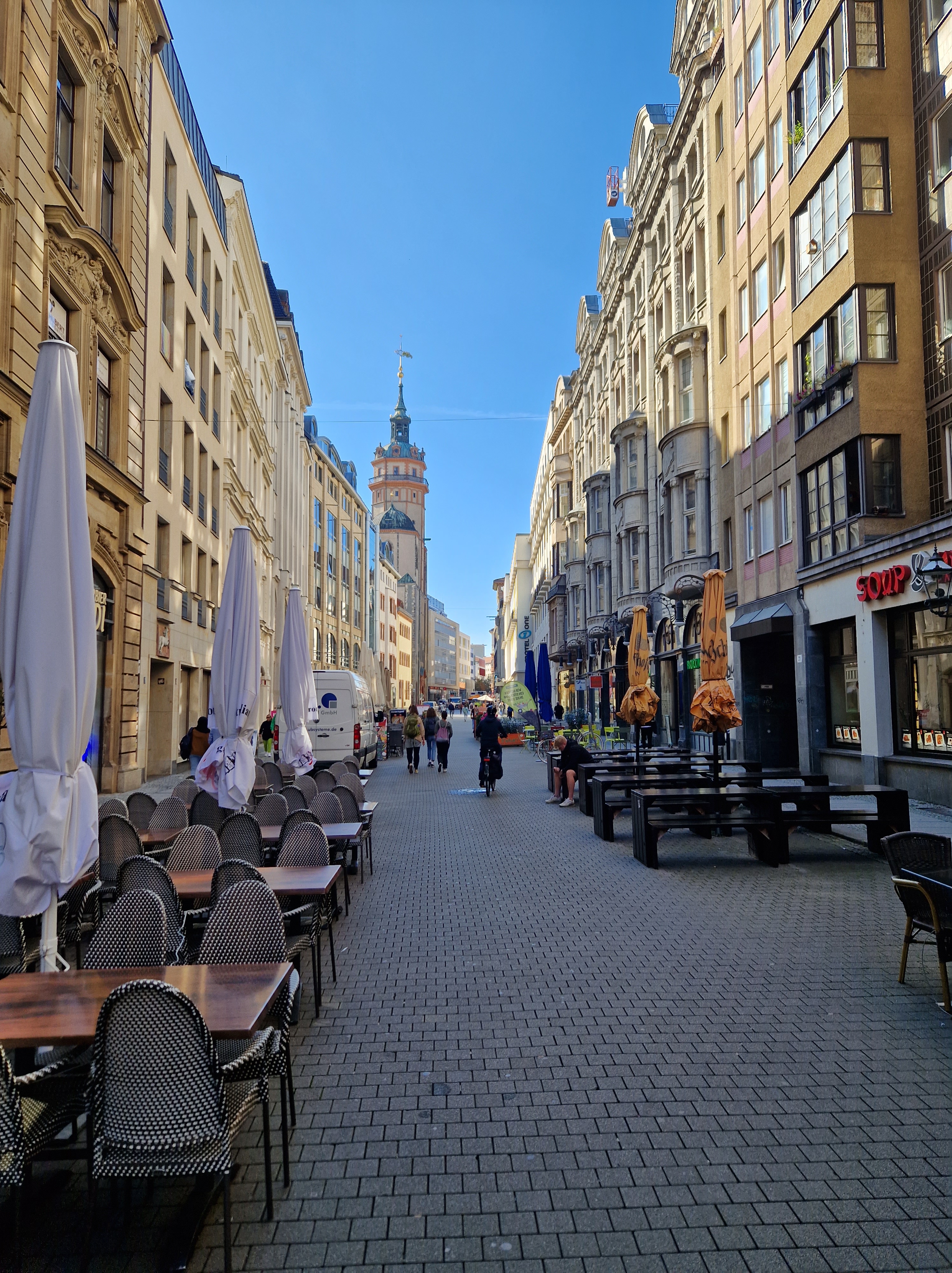
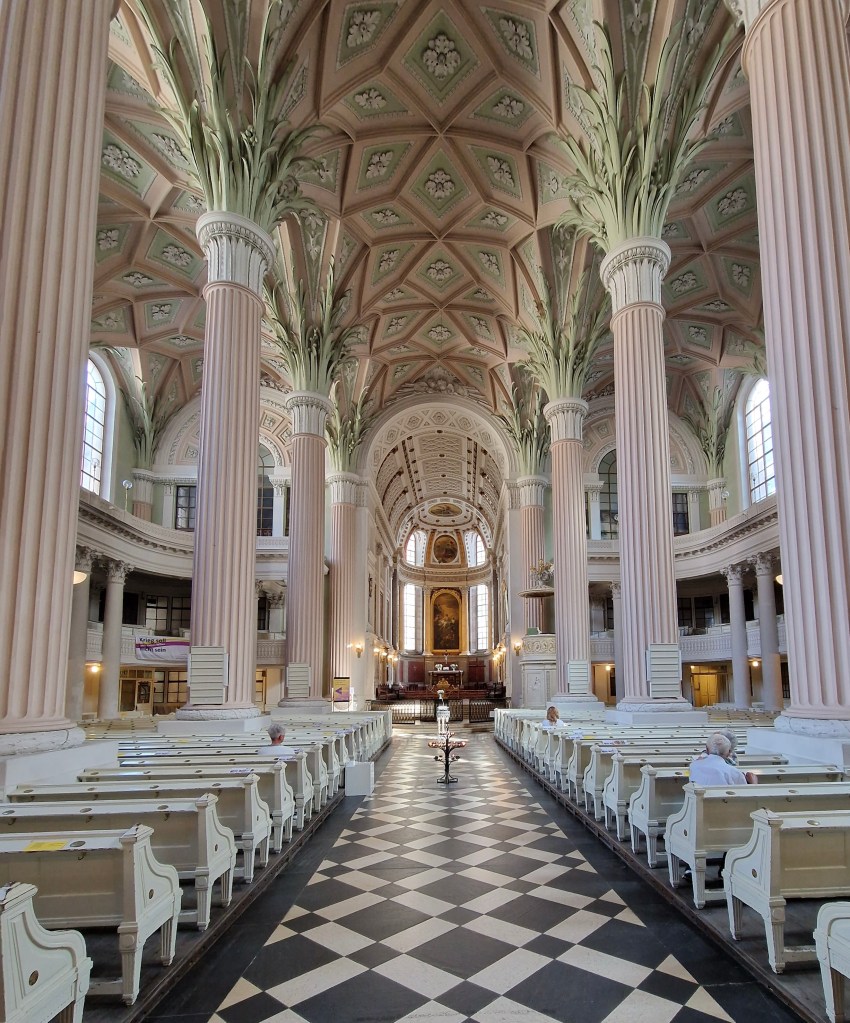
The final stop of the day was St. Nicholas’s Church. This church dates mostly from the sixteenth century and was, alongside St. Thomas’s, the place where the two main city choirs would perform Bach cantatas, masses, and Passions. My interest in seeing this church was primarily to do with my favourite large-scale choral work, The St. John Passion, first being performed here on Good Friday 1724. It was supposed to have been performed in St. Thomas’s, but the council changed the venue. Bach was irritated, pointing out that the booklets had been printed, the harpsichord would need repairing, and there was no room for the extra musicians he needed; however, the council agreed to repairs, made more room in the organ loft, and printed flyers for the event at St. Nicholas’s. I went to a performance of the St. John Passion on Good Friday 2024, the 300th anniversary of this first performance, but unfortunately not in St. Nicholas’s. The concert I attended was at the splendid Birmingham Symphony Hall, and was staged to be an historical recreation of the first performance in St. Nicholas. It did make it special, not only having been to St. Nicholas the previous year, but also having my daughter with me for her first experience of a Bach Passion. The outside of St. Nicholas is fairly plain, although the tower is impressive, and sits now in a main shopping area; however, the inside is stunning. I had got used to the Lutheran plain Gothic interiors, but this church had a makeover in the late eighteenth century, which added white, green, and pink elaborate columns and ceilings. It was the most beautiful interior I had seen on my trip, somewhat ornate, but not overdone, as is sometimes the case in Baroque-style churches.
Having enthused about the music Bach produced in Köthen, I have to say that the sheer quality and volume of music he produced in the twenty-seven years in Leipzig is quite remarkable. Choir music is not a genre I have listened to a lot, and I am therefore very ignorant when it comes to Bach’s numerous cantatas. I have come across some, usually from concert performances, that I really like parts of, for example, the exquisite final aria and chorus of BWV 179. I do love the St. John and St. Matthew Passions, probably because they have real drama throughout the music, although I appreciate there are dramatic arias within many cantatas. For the first ten years of his time as Kantor, Bach produced a continuous stream of music for the Leipzig churches, but this did slow down in the 1730s and by 1740 dried up completely. Scholars have put this down to his continuous wrangling with his superiors at the school. One of the things that I have learnt about Bach on this trip is that he had issues with authority. We don’t have many letters from Bach, but in those we do have, he does seem to do a lot of moaning, either about his treatment by authorities, or not being paid enough, or high tax on wines, or the poor quality of musicians/singers. I think it’s fair to say that Bach was somewhat cantankerous, and many music scholars have written how this seems at odds with the sublime music he writes; however, for me, this is all part of this complex man. Although I wouldn’t have liked to have crossed him, I would have loved to have been in the room when he had friends around to have a few beers and play music.
Whilst slowing down the production of music for the Leipzig churches, Bach found another outlet for his creativity. In 1729, he assumed directorship of Collegium Musicum, a talented group of professional musicians. Bach mainly reworked previous pieces for this ensemble, but he actively led them in weekly concerts, mainly in the Café Zimmerman, which was unfortunately destroyed in WW2.
Towards the end of his life, Bach would focus on private pursuits, such as revising previous works for publication, and developing abstract works that were not intended for performance, but were rather intellectual exercises to demonstrate the science and ingenuity of music. Two of these, The Musical Offering and The Art of Fugue, have become pillars of European musical understanding. The Musical Offering stems from a challenge given to Bach by King Frederick the Great in May 1747. Bach was visiting his son, Carl, in Berlin when the King found out and invited him to Potsdam. The King sat at the harpsichord and played Bach a few lines of music, and asked him to develop these into a three-part fugue based on this ‘theme’, which Bach did on the spot. He then upped the stakes and asked him to improvise a six-part fugue. Bach deferred, saying the theme does not lend itself to this, but improvised a six-part fugue based on his own theme. On his way back to Leipzig, he took up the challenge and produced a six-part fugue based on the ‘unusual’ King’s theme, and sent it to him as a ‘Musical Offering’. I went to see a stage play (The Score) about this encounter last year at the London Haymarket, with Brian Cox playing a grumpy old Bach (almost typecast). It was entertaining, but for the Bach enthusiast, it took a few artistic liberties! The Art of Fugue is the last thing Bach was working on. I still find it hard to listen to Contrapunctus XIV, where the music just suddenly stops. A note is written on the manuscript at this point by his son, Carl Philip Emanuel, to say “Upon this fugue, where the name BACH was introduced in the countersubject, the author died.”
Another piece written in this last period of Bach’s life was the Goldberg Variations. These were apparently written as a sleep aid for Count von Kayserling, a Russian ambassador. His poor harpsichordist, Johann Goldberg, had to play music through the night to entertain the sleepless Count. The count commissioned Bach to write something to help him sleep, and Bach obliged with a wonderful aria and thirty variations. Count von Kayserling would be no music lover if he did manage to sleep to this, as this piece of music would be in the top three for most Bach fans, and is certainly in mine. I first heard this from the 1955 Glen Gould recording, and was awestruck by the speed, energy, and technical brilliance of Mr Gould. This recording became a bestseller and launched his career. He recorded it again in 1981, shortly before his untimely death, but this time much slower and measured, leaving lots of space in the music. To paraphrase Mozart, it’s not the notes, but the silence between them that is important; and I don’t believe anyone shows this more than Glen Gould in this 1981 recording. Every time I listen to the aria from this recording, I struggle to understand how something so seemingly simple can be so profound and utterly beautiful.
I thought I would spend my last day in Leipzig by visiting the university, walking the city, and doing some reflecting on the many years Bach spent here; however, it was another beautiful day, so I thought why not follow my fellow hotel guests, and go to the world-famous zoo! I had a lovely day in the sunshine, but still not sure how I feel about zoos, but here the animals do seem to have a lot of space. The next day I was on an early train to Berlin, and then the shuttle to the airport for my flight home. I have since reflected on this trip, and I do feel a bit closer to the man and his music. It was such a thrill to walk in Bach’s footsteps, from his accommodation to the churches or palaces that he worked in. I certainly seem to get more out of my listening now, knowing a little about where the music was written and who it was written for. A final lesson learnt is that there are so many beautiful towns and cities to visit that are not on most tourist trails! If you have reached this point then I assume you have similar musical interests, and therefore I hope you may have found some of this useful if contemplating a similar musical journey.
Leipzig

Books that Inspired the Trip
Exploring the world of J.S. Bach, A Traveller’s Guide. Robert L. Marshall and Traute M. Marshall. University of Illinois Press. 2016.
The Bach Cello Suites, A Companion. Steven Isserlis. Faber. 2021.
Master Musicians, Bach. Eva Mary and Sydney Grew. J.M. Dent & Sons. 1947.
Music in the Castle of Heaven, A Portrait of Johann Sebastian Bach. John Eliot Gardner. Penguin Books. 2013.
Bach. Nicholas Kenyon. Faber Pocket Guide. 2011.

